

Most labs can tell you their process, but far fewer can describe their space in the same deliberate way. And yet, the space decides how that process behaves in real time. A layout can either support steady work or quietly introduce friction: extra handling, backtracking, clutter on benches, and small delays that are hard to trace because they are spread across the day.
The placement of lab storage cabinets is a good example. Storage looks like a support element, but it determines where materials accumulate, how often people break concentration to fetch items, and whether worktops remain worktops or turn into temporary shelving. In a well-planned lab, the layout absorbs complexity and keeps daily work predictable. In a poorly planned one, the same team and equipment still function, but at a higher cost in time, effort, and avoidable error.
How Laboratory Layout Shapes Daily Workflows
If you watch a lab during peak hours, you can see the layout working, or failing, without needing a stopwatch. People hesitate at pinch points. Two tasks compete for the same surface. Someone waits to access a shared instrument because the approach route is blocked by a trolley. None of this is dramatic, but it is persistent.
Layout shapes workflows in three practical ways:
- Task sequencing: Whether the order of work feels natural (receive → prep → test → record → dispose) or forces repeated cross-traffic.
- Shared resources: Where printers, balances, wash areas, and common instruments sit, and whether access remains clear when multiple staff are active.
- Interruption frequency: How often a technician has to step away mid-task because something essential is stored elsewhere.
The most common layout problems are not wrong on paper. They are simply mismatched to real behaviour. A lab can be compliant and still inefficient, particularly when the design does not account for how people actually move when the lab is busy.
Lab Storage Cabinets as the Backbone of Efficient Layouts
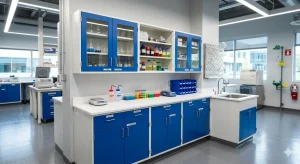
Storage is one of the fastest ways to improve or damage efficiency because it influences everyday decisions. If laboratory storage cabinets are placed far from where work happens, technicians will not stop mid-process to return items properly, especially during high-volume periods. They will stage materials on the bench “for now”, and that becomes the new normal.
Good storage planning is less about adding cabinets and more about placing them with intent:
- High-use items should be within easy reach of the workstation that consumes them.
- Secondary supplies can be slightly farther, but still accessible without crossing active zones.
- Storage should support clean habits, meaning it should make the correct action convenient.
This is where lab storage cabinets become a layout tool rather than a procurement line item. When they are positioned well, benches stay clear, movement reduces naturally, and work feels less interrupted.
The Role of Zoning in Reducing Congestion and Cross-Contamination
Zoning is not about labels on the floor. It is about preventing incompatible activities from colliding in the same physical space. In well-run labs, the zones are clear even without signage because the layout reinforces them.
Effective zoning typically separates:
- sample receiving and documentation
- preparation and weighing
- wet work and wash-up
- instrument testing
- waste handling and temporary storage
Storage reinforces zoning more than most teams expect. When laboratory storage cabinets are located inside their relevant zones, materials stay where they belong, and the layout reduces cross-traffic automatically. When storage is centralised without logic, people move materials across zones repeatedly, increasing handling and raising the chance of mix-ups or contamination.
The point is simple: zoning is a risk control and an efficiency control at the same time.
Plinth System and Its Influence on Cleanliness and Stability
The plinth system rarely gets attention during planning, but it influences maintenance and hygiene every day the lab operates. If you have ever tried to clean under cabinets without a proper base, you know why this matters: dust collects, liquids seep into corners, and what should be routine cleaning becomes a tedious workaround.
A properly designed plinth system supports the lab in three practical ways:
- It reduces hard-to-clean gaps under cabinets, which improves daily housekeeping.
- It limits moisture exposure at cabinet bases, which helps storage last longer.
- It improves stability, especially in areas where cabinets support equipment or heavy loads.
In labs with frequent wet work or aggressive cleaning routines, this is not a minor detail. It is part of how the lab stays consistent over time, rather than slowly degrading in ways that affect cleanliness and appearance.
Integrating Storage, Furniture, and Services Into One System
A common failure point in lab projects is treating storage, furniture, and services as separate packages. On-site, they collide. Service points end up inaccessible. Cabinets block routes. Safety equipment becomes difficult to approach during an incident because something practical was placed in the wrong spot.
Efficient labs plan as one system:
- Lab storage cabinets and benches aligned to utilities so connection points are not improvised later.
- Storage positioned with safety equipment in mind, not as leftover placement.
- Access routes maintained, including during busy periods when stools and carts appear.
Common Layout Mistakes That Reduce Laboratory Efficiency
Some mistakes repeat across labs of all sizes, often because the issues only appear after real work begins.
Common layout mistakes include:
- Placing too much storage inside active work zones, reducing usable bench space.
- Installing cabinets without accounting for door swing, creating daily access irritation.
- Designing for today’s equipment only, with no allowance for upgrades or additional capacity.
These are not catastrophic errors, but they are expensive in the long run because they create constant micro-friction: small delays, extra handling, more clutter, and a higher reliance on manual discipline to keep order.
Planning for Growth Without Compromising Efficiency
Planning for growth is not the same as leaving large empty areas “just in case”. It is about building flexibility into the layout so change can happen without disruption.
Three practical strategies tend to work well:
- Use modular lab furniture where reconfiguration is likely.
- Reserve sensible locations for additional lab storage cabinets so expansion does not push storage into worktops.
- Keep primary movement paths protected, meaning they remain clear even when workload increases.
When growth is considered early, labs scale more cleanly. When it is ignored, growth arrives anyway, and the layout absorbs it through clutter and workarounds.
Final Thoughts
A laboratory layout is not a styling exercise. It is a working model, and like any working model, it either reduces variability or amplifies it. Decisions about laboratory storage cabinets, zoning, a plinth system, and modular lab furniture influence how reliably work is executed and how easily safety is maintained during real-world pressure.
Efficient labs are rarely lucky. They are planned with a clear understanding of how work moves, where risk concentrates, and how the lab will change over time. When layout supports those realities, efficiency becomes easier to sustain, not something the team has to fight for every day.