
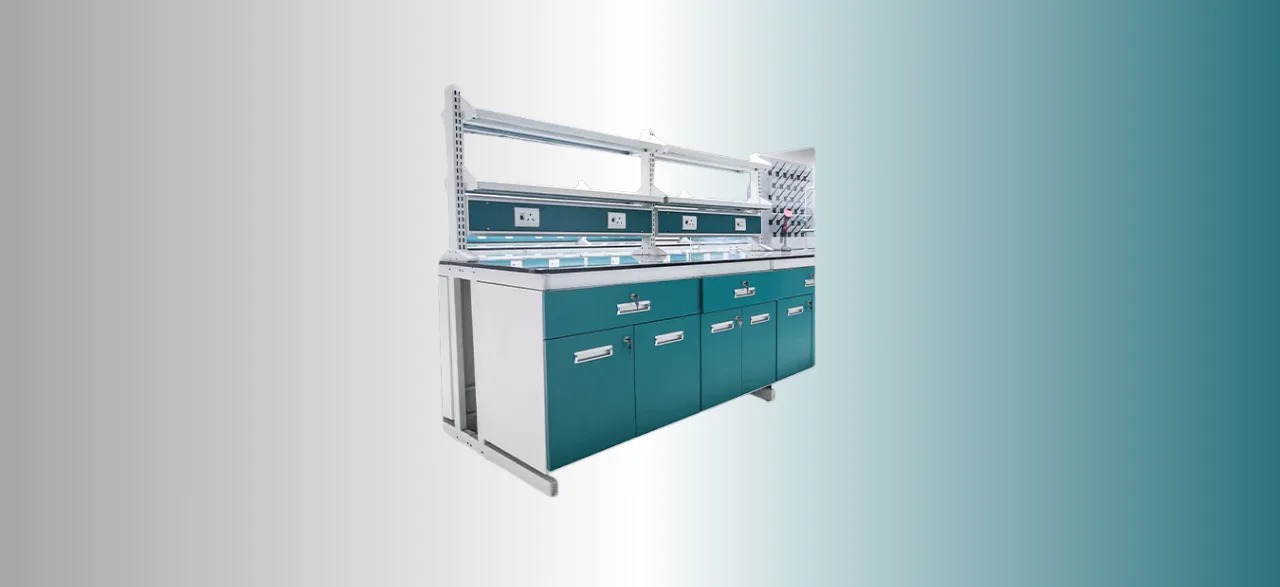
In a working lab, furniture is not “background”. It is the thing people touch all day. If a bench is 50 mm too deep, you see technicians leaning forward for hours. If storage is placed on the wrong side of the workflow, you see bottles living on the worktop because returning them is inconvenient during a run. If aisles are tight, carts stop moving and people start carrying more than they should.
That is why custom lab furniture is rarely about aesthetics in serious lab environments. It is about getting the physical setup aligned to the way the lab actually functions: how samples move, where equipment sits permanently, where waste is generated, where clean items need to stay clean, and how many people use a zone at the same time. When furniture reflects those realities, the lab behaves more predictably, and both safety and productivity become easier to maintain without constant correction.
Where Standard Laboratory Furniture Creates Constraints
Standard laboratory furniture is designed to be acceptable in many labs. The problem is that labs do not operate on averages.
The constraints are usually practical, not theoretical. A bench may fit the analyser, but the side clearance needed for routine servicing is missing, so the unit is rotated, and suddenly the cable routing becomes messy. A reagent cabinet may be present, but positioned behind a busy workstation, so access becomes awkward during peak hours. A sink may be installed where it suits plumbing, not where the wet work happens, so people end up moving drips and splashes across a dry zone.
These are small compromises, but they do not stay small. They create habits: temporary storage on benches, ad-hoc trolleys, additional racks, improvised segregation. The lab still runs, but it runs with friction, and friction eventually becomes risk.
Safety Improvements Through Custom Lab Furniture Design
Safety improves fastest when the layout makes the safe method the easiest method. If safe behaviour requires extra effort every time, people will drift, especially during busy periods.
Custom lab furniture supports safer operation through decisions that are simple but decisive:
- Separation between activities that should not overlap
Wet processes, weighing, sample receiving, and documentation do not need dramatic barriers, but they do need clear zones so contamination and mix-ups are less likely. - Clear access around higher-risk equipment
Fume handling, heating, and chemical prep areas need space that remains space, not a temporary parking zone for stools and trays. - Storage positioned to reduce unnecessary handling
When chemicals or consumables are stored where the work happens, people carry less, spill less, and do not create bench-top “temporary” storage that becomes permanent. - Work surfaces designed for realistic cleaning and spill control
Smooth transitions, fewer grime traps, and sensible edge detailing make cleaning practical, not aspirational.
Workflow Stability Begins with Furniture Planning
A lab can have a good process and still run badly if the physical flow fights the process. In most labs, the biggest delays are not big failures. They are queues, rework, and waiting, caused by layout.
Custom lab furniture helps workflow because it allows planning around how work sequences actually occur. For example, sample receiving and labelling should not send people back and forth across active testing zones. Instrument benches should allow access for both operation and routine maintenance without forcing equipment to be moved. Shared resources, such as balances, printers, or wash stations, should sit where they do not create a choke point.
When furniture planning is done with workflow in mind, you typically see three changes on the floor: fewer crossed paths, fewer interruptions during runs, and fewer workarounds introduced by staff to keep up with volume.
Addressing Functional Differences Across Lab Types
Not every lab needs the same kind of custom. A common mistake in first-time projects is to treat customisation as an all-or-nothing decision.
Research environments often need flexibility, because layouts change when projects change. QC environments usually benefit more from fixed, repeatable workstations that support consistency. Teaching labs tend to need durability and straightforward supervision, because multiple users interact with the same stations.
The point of customisation is to fit furniture to the operating model of the lab. Done properly, it is selective: you customise where the function demands it, and you keep modularity where it supports change.
Coordinating Furniture with Utilities and Safety Systems
Furniture, utilities, and safety systems cannot be treated as separate packages without consequences. If benches are placed first and services are made to fit, you end up with awkward access, exposed routing, or safety equipment that is technically present but poorly usable.
Custom lab furniture allows coordinated planning so that benches line up with service points, storage does not block access, and safety infrastructure sits where it is genuinely reachable in an incident. The benefit is not only neatness. It is operational: fewer obstructions, fewer compromises during installation, and less retrofit culture after handover.
Durability and Maintenance as Operational Considerations
A lab is not a showroom. It is a working space. Furniture has to handle routine chemical contact, repeated cleaning, constant opening and closing, and occasional accidents.
Durability matters because maintenance issues become workflow issues. Swollen panels, degraded surfaces, or loose fixtures create small disruptions that repeat weekly. Cleaning becomes harder, which reduces consistency and increases contamination risk. Replacement work introduces downtime.
Custom lab furniture can be designed with the lab’s actual maintenance reality in mind: the cleaning regime, the exposure patterns, and the high-wear zones. This keeps the lab stable over time, not just on day one.
Santech Labs’ Approach to Custom Laboratory Furniture
At Santech Labs, customisation is not treated as a design upgrade. It is treated as an operational exercise: what the lab does, how it does it, and where the real risks and bottlenecks sit.
That approach typically involves understanding user routines, mapping movement patterns, aligning furniture with utilities early, and designing storage and work zones to reflect how the lab will be used under normal and peak conditions. The aim is straightforward: furniture that supports daily work without demanding constant adjustment from the team.
Rethinking Common Assumptions About Custom Furniture
Custom lab furniture is often assumed to be expensive, slow, or unnecessarily complex. Those assumptions usually come from projects where customisation was applied broadly without discipline.
In reality, the most effective customisation is targeted. It focuses on solving known constraints: clearance issues, zoning needs, storage discipline, and workflow bottlenecks. When custom furniture reduces rework, prevents retrofits, and supports consistent operation, the value shows up over the life of the lab, not at the purchase stage.
Final Perspective
A lab that runs well is rarely managed into efficiency. It is designed into it.
Custom lab furniture improves safety and workflow by reducing the need for workarounds, supporting logical movement and zoning, and aligning the physical environment with operational reality. When furniture fits the work, the lab becomes easier to run, easier to keep compliant, and easier to scale.
That stability is what most labs want in the end: predictable performance, without constant fixes.