
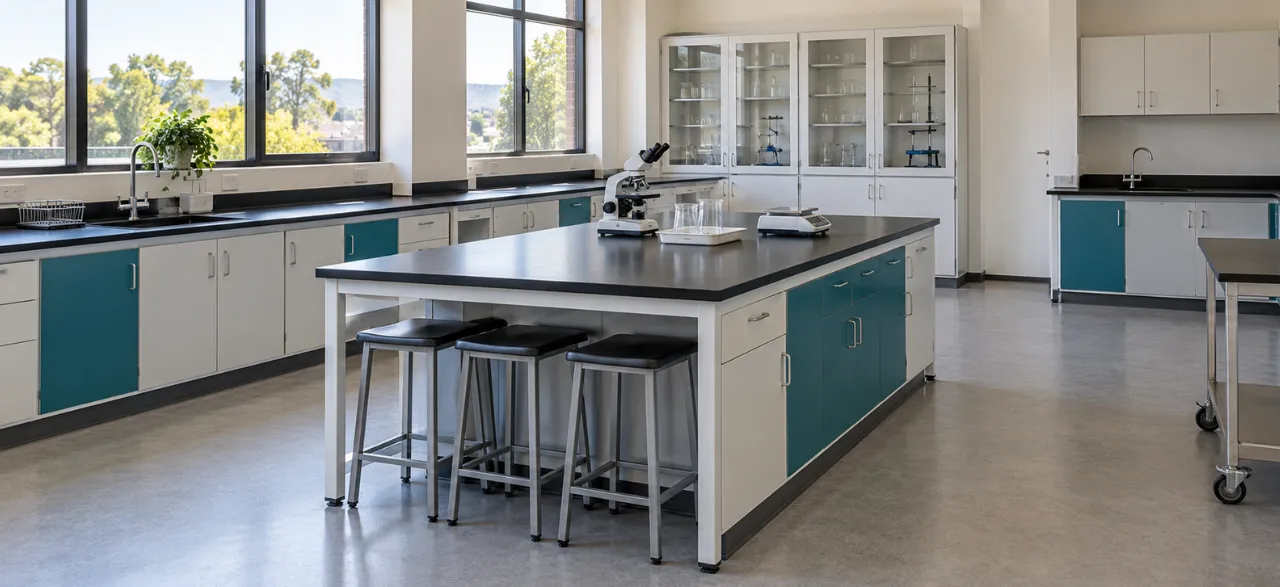
An integrated science lab combines facilities for subjects such as chemistry, physics, and biology in one flexible, well-planned space. Schools can create an effective integrated science lab without using a large room or an excessive budget by planning the layout, selecting versatile science lab equipment, maximising storage, and using flexible laboratory furniture.
A well-designed lab should provide students with a safe and practical environment for experiments, demonstrations, and collaborative learning while making efficient use of available space and resources. The key is to avoid unnecessary duplication of equipment and furniture while ensuring essential facilities, workstations, storage, utilities, and safety provisions are available.
In this guide, we cover 7 practical ways to optimise space and budget in an integrated science lab, from planning the layout before purchasing equipment to using shared storage, flexible furniture, safe design practices, and phased laboratory development.
What Is an Integrated Science Lab?
An integrated science lab is a flexible laboratory designed to support practical learning across multiple science subjects, such as physics, chemistry, biology, and general science, within one shared space. Instead of maintaining separate laboratories for each subject, schools can use adaptable workstations, shared science lab equipment, efficient storage, and flexible furniture to maximise space and resources. With proper planning, an integrated science lab can help schools create a safe, versatile, and cost-effective environment for practical learning.
What Makes an Integrated Science Lab Different?
The idea behind an integrated laboratory is to have a single lab where all sciences are covered. This means that, rather than setting up three separate labs, namely one each for physics, chemistry, and biology, a school will be able to utilize an intelligently planned lab.
It could help in better utilization of space as well as avoiding duplication of lab equipment.
| Feature | Benefit |
|---|---|
| Flexible workstations | Supports different practical activities |
| Shared equipment | Reduces unnecessary purchases |
| Smart storage | Keeps equipment accessible without using excess floor space |
| Multi-purpose worktops | Supports chemistry, physics, and biology activities |
| Mobile furniture | Makes room layouts easier to change |
| Centralized services | Helps organise water, electricity, and other connections |
1. Plan the Layout Before Buying Equipment
The simplest way to keep the cost of designing a lab low is to design the room before you purchase any equipment or furniture for it.
First of all, measure your room and locate such objects as doors, windows, sink, electrical outlets, etc., and think about the way people will move in the room.
The simplest way to keep the cost of designing a lab low is to design the room before you purchase any equipment or furniture for it.
First of all, measure your room and locate such objects as doors, windows, sink, electrical outlets, etc., and think about the way people will move in the room.
The proper arrangement in the integrated science lab should provide clear paths between workstations, storage, and demonstration areas, etc. Try not to overcrowd the room with equipment and furniture. Both students and teachers need enough free space to work comfortably. A well-planned education lab setup can help schools organise these zones efficiently while making better use of the available space.
Your room layout can be as simple as follows:
- Workstation(s) for students
- Demonstration area for the teacher
- Storage cabinets
- Preparation area
- Cleaning and washing area
- Equipment storage
- Movement pathways
These zones may be planned beforehand to avoid costly modifications in the future.
2. Choose Multi-Purpose School Lab Equipment
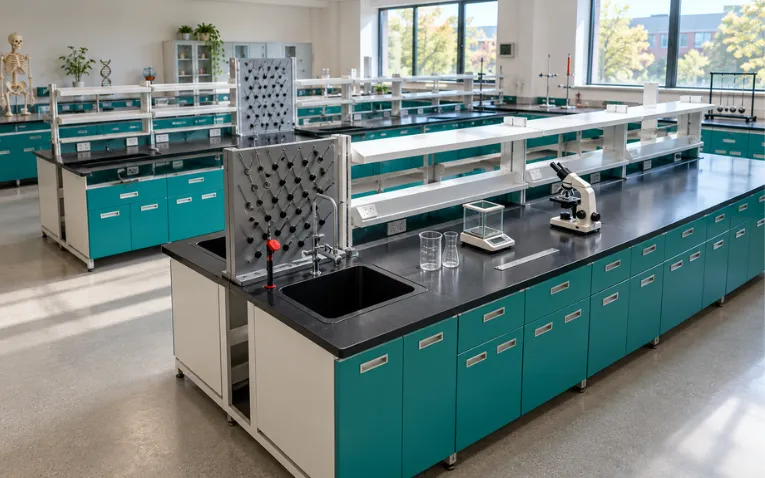
Schools do not always have to use separate equipment for each science subject. Selecting versatile school lab equipment would allow avoiding redundancy and making the laboratory more productive.
For instance, desks can be used for carrying out activities related to biology, chemistry, and physics. Likewise, simple measuring tools, microscopes, balances, and other equipment that is often used can be shared between groups if there is an appropriate schedule.
In previous times, the RSC pointed out the significance of having appropriate equipment and facilities for practical science. According to its research, secondary state schools and sixth-form colleges had only 70% of the necessary equipment and consumables for conducting science lessons.
Instead of purchasing lots of equipment that will rarely be used, schools can focus on buying equipment that can be used for many different experiments.
A practical purchasing approach
| Priority | Equipment Approach |
|---|---|
| High | Frequently used equipment |
| Medium | Equipment shared between subjects |
| Low | Specialist equipment used occasionally |
| Future | Equipment that can be added as the budget allows |
3. Use Vertical Space for Storage
Floor area is important for every laboratory. Instead of taking up floor space with cabinets all over the place, take advantage of walls and vertical storage when possible.
Wall storage such as cabinets, shelves, and storage units can help to store scientific equipment without occupying too much working space.
For laboratories that need to maximise storage without taking up unnecessary floor space, laboratory storage cabinets can help organise equipment, materials and supplies while keeping frequently used items accessible.
It is important that storage does not simply mean storing all the equipment as high as possible. Equipment that will be used very often should be kept in easy-to-reach places, while those used less often can be kept up high.
Proper storage helps in organizing the inventory too. It is easy for teachers and technicians to know what equipment is there and therefore avoid buying duplicate equipment.
4. Invest in Flexible and Mobile Furniture
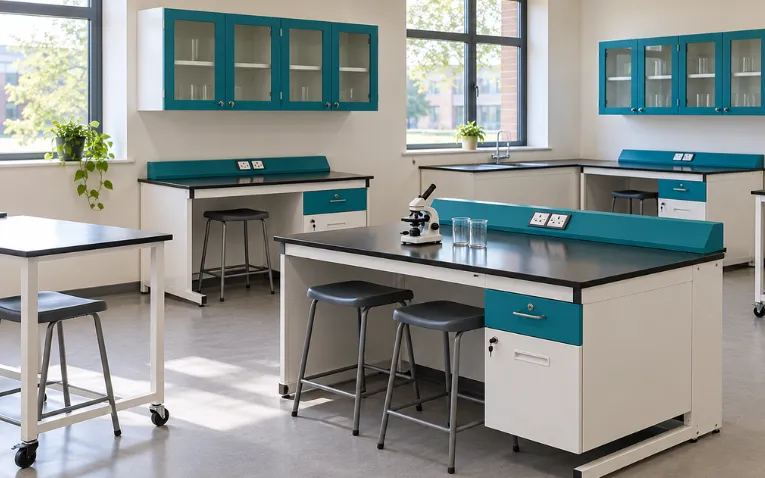
Inability to modify the design of a laboratory becomes a problem if different classes require different arrangements. Mobile tables, movable chairs, and the C-Frame System can help create flexible work areas that support demonstrations, experiments, and individual activities.
For instance, it is possible to arrange tables in small groups for conducting collaborative experiments and then move them apart when students require individual workspaces.
This approach is particularly helpful in an integrated science laboratory where one room is used for different subjects during the day.
In this way, schools can create a flexible laboratory environment without needing separate arrangements for different subjects.
5. Create a Shared Equipment and Storage System
Purchasing equipment is just one aspect of the budget. It is also important for schools to consider issues related to storage, maintenance, and replacement of equipment.
Use of a common inventory system would help in making the teachers aware of the laboratory equipment available. The equipment that is shared among different subjects can be scheduled instead of being purchased repeatedly.
For instance:
| Equipment | Possible Use |
|---|---|
| Microscopes | Biology and general science |
| Digital balances | Chemistry and physics |
| Measuring cylinders | Chemistry and general experiments |
| Thermometers | Physics, chemistry, and biology |
| Power supplies | Physics and electronics activities |
| Safety equipment | Multiple practical activities |
Such an approach would help cut back on unnecessary expenses while still ensuring that all necessary equipment is available.
Other issues highlighted by the RSC 2024 report included the cost of chemicals and consumables, and lack of equipment and technicians.
6. Make Safety Part of the Design
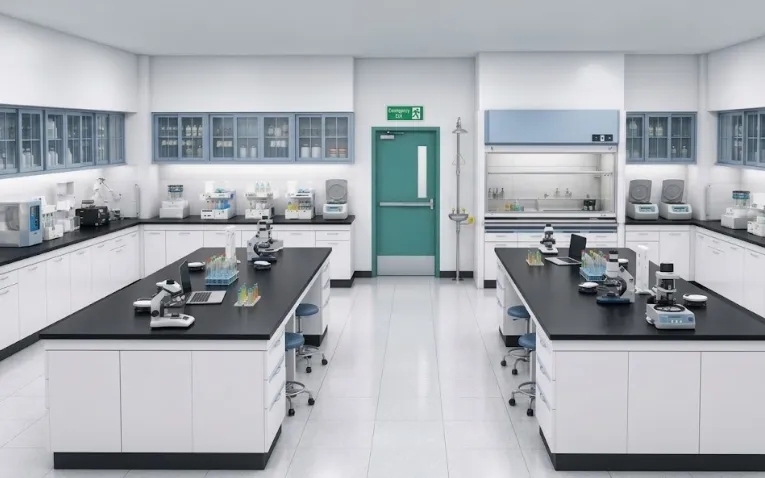
Space efficiency must not come at the expense of safety.
The efficient design of the science laboratory in the school will ensure adequate ventilation, walkways, and storage along with access to emergency facilities. The chemical storage, electricity supply, heating, and other facilities will depend on the type of activities taking place in the laboratory.
The UK Health and Safety Executive maintains that science laboratories may carry more risk compared to ordinary classrooms, and risks need to be managed proportionately in these laboratories.
This would imply that safety needs to be incorporated right at the start when designing the laboratory.
Some of the safety considerations are as follows:
- Walkway for movement
- Appropriate storage of chemicals
- Suitable ventilation
- Safe electrical connection
- Access to emergency equipment
- Waste disposal area
- Special equipment storage
- Safety signs
Along with incorporating safety into the laboratory design, schools should establish clear procedures for students and staff. These laboratory safety tips can help reinforce safe practices for PPE, chemical handling, equipment use, waste disposal and emergency situations.
7. Build the Laboratory in Phases
All the items cannot be acquired at once. It is better to adopt a step-by-step process to make the whole setup easier financially.
Begin with setting up the infrastructure and equipment required for the day-to-day lessons. After getting the basic laboratory ready, more equipment can be brought in according to the needs of the syllabus and budget.
| Phase | Main Focus |
|---|---|
| Phase 1 | Layout, workstations, utilities, and safety |
| Phase 2 | Essential science equipment |
| Phase 3 | Additional storage and specialist equipment |
| Phase 4 | Digital tools and advanced equipment |
| Phase 5 | Upgrades and replacement |
This strategy helps schools distribute costs through time rather than incurring all costs in one single budget period.
This also assists decision-makers in identifying purchases that have the most effect on learning.
What Equipment Is Needed for an Integrated Science Lab?
An integrated science lab needs a combination of school lab equipment that can support practical activities across physics, chemistry, biology, and general science. Instead of purchasing separate equipment for every subject, schools can prioritise versatile and frequently used items that can be shared between classes.
Common science lab equipment may include microscopes, digital balances, thermometers, measuring cylinders, glassware, power supplies, basic physics apparatus, models, specimen-related equipment, and appropriate safety equipment. The exact requirements should depend on the curriculum, student capacity, practical activities, and level of study.
Schools should prioritise equipment that is frequently required across multiple subjects before investing in specialised items. Reviewing essential laboratory equipment can also help decision-makers build a practical equipment list while keeping the available budget under control.
| Category | Examples of Equipment | Primary Use |
|---|---|---|
| Biology | Microscopes, slides, models | Observation and biological studies |
| Chemistry | Glassware, balances, measuring equipment | Experiments and material analysis |
| Physics | Power supplies, measuring instruments, physics apparatus | Practical measurements and experiments |
| General Science | Thermometers, measuring cylinders, basic apparatus | Shared science activities |
| Safety | PPE, first-aid equipment, safety accessories | Safe practical learning |
A well-planned equipment list helps schools avoid unnecessary purchases while ensuring that students have access to the equipment required for practical learning.
How Much Does an Integrated Science Lab Cost?
The integrated science lab cost varies depending on the room size, number of students, laboratory furniture, equipment requirements, storage, utilities, safety provisions, installation, and level of customisation. Therefore, there is no single laboratory setup cost that applies to every school.
The main factors that influence laboratory setup cost include:
| Category | Examples of Equipment | Primary Use |
|---|---|---|
| Biology | Microscopes, slides, models | Observation and biological studies |
| Chemistry | Glassware, balances, measuring equipment | Experiments and material analysis |
| Physics | Power supplies, measuring instruments, physics apparatus | Practical measurements and experiments |
| General Science | Thermometers, measuring cylinders, basic apparatus | Shared science activities |
| Safety | PPE, first-aid equipment, safety accessories | Safe practical learning |
Schools can manage costs by planning the laboratory layout before purchasing equipment, selecting multi-purpose school lab equipment, using shared storage and workstations, and implementing the setup in phases. A phased approach allows essential infrastructure and equipment to be prioritised first, while additional equipment and upgrades can be introduced as requirements and budgets evolve.
For an accurate budget, schools should assess their student capacity, curriculum requirements, available space and required level of laboratory functionality before finalising the laboratory design and equipment list.
Why Smart Planning Matters for Science Labs
For the modern-day science laboratory, the emphasis should not be on occupying every single corner with furniture and science lab equipment, but rather it should be on providing a conducive atmosphere for learning, experimenting, and working within safe limits.
Such an observation is significant because the availability of practical science has been known to vary in terms of funding, equipment, and infrastructure. According to the RSC’s 2026 Science Teaching Survey, the practice of conducting practical work has become less frequent in most nations compared to 2025.
An efficiently designed and integrated science lab can assist the school in making efficient use of its resources without compromising its flexibility.
Conclusion
An integrated science lab can maximise available space and control costs by combining flexible laboratory furniture, shared science lab equipment, smart storage, safe utilities, and phased investment. The most effective approach is to plan the layout and infrastructure before purchasing, prioritise multi-purpose equipment, use vertical storage, choose flexible workstations, and expand the lab according to teaching requirements and budget.
For schools planning a new laboratory or upgrading an existing one, the right lab furniture manufacturers can make a significant difference to space utilisation, safety, durability, and long-term value. Santech Labs provides customised laboratory furniture solutions for educational environments, helping schools create practical, flexible, and efficient science laboratories.
With smart planning and the right furniture and equipment, schools can build an integrated science lab that uses space efficiently, avoids unnecessary equipment duplication, manages laboratory setup costs, and supports effective practical learning.