
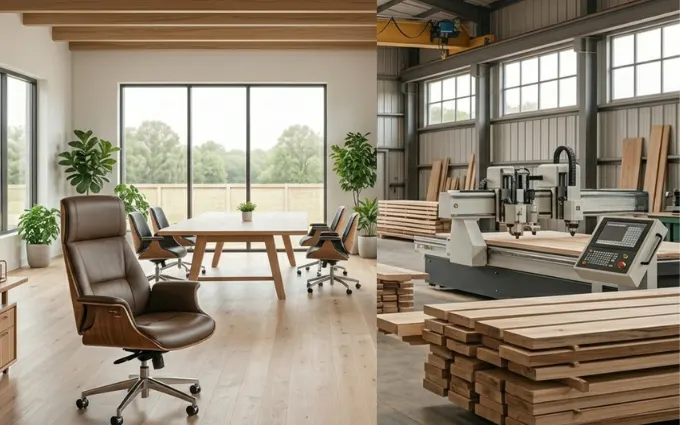
Not long ago, sustainability in furniture projects was treated as a preference. If the budget allowed, clients explored eco-friendly options. If it did not, the conversation ended quickly. That mindset has shifted. Today, environmental performance is part of the core brief. Clients want clarity on where materials come from, how products are made, and how long they will last.
For any serious furniture manufacturer, this changes the responsibility entirely. Manufacturing is no longer just about delivering finished pieces. It is about managing impact at every stage, from sourcing to installation to eventual replacement. Sustainable innovation is not a marketing layer. It is an operational discipline that shapes daily decisions on the factory floor.
Why Sustainability Is No Longer Optional in Furniture Manufacturing
Changing Buyer Expectations
Buyers are more prepared now. They have internal targets and reporting obligations. Many organisations link vendor performance to ESG commitments, and furniture is part of that assessment.
So the questions are no longer casual. They are direct, and they come early:
- Can we trace the timber to a certified source?
- Are the boards low-emission, and can we prove it?
- If a part gets damaged, can we replace the part, or do we replace the whole unit?
- Do we have certifications and compliance documents ready when asked?
When a furniture manufacturer can answer these cleanly, it builds trust fast. When the answers are vague, the conversation usually ends politely and moves on.
Environmental Impact of Traditional Manufacturing
Traditional manufacturing was built around output and speed. That approach delivered scale, but it also produced waste most people never saw. Offcuts that could not be reused. Finishes that released strong emissions. Furniture that looked fine at handover but started failing earlier than it should, which pushed replacement and disposal.
Over time, the industry fell into patterns that became hard to justify:
- Timber without clear traceability
- High energy consumption during production
- VOC-heavy finishes affecting indoor environments
- Furniture discarded because repair wasn’t practical
Those habits are being challenged now, not only by regulations but also by client expectations and basic operational logic.
Energy-Efficient Production Practices
Optimised Manufacturing Processes
Sustainability is often decided inside the factory, in details that rarely make it into project meetings. Cutting plans. Machine time. Idle cycles. The difference between a production line that runs with discipline and one that keeps improvising.
Precision tools such as CNC systems help because they reduce waste. Cuts are cleaner. Measurements stay consistent. Errors drop. That means fewer rejected parts and fewer remakes, which is an environmental win even if nobody puts it on a poster.
Energy efficiency improves when processes are tightened up:
- Better cutting layouts to reduce offcuts
- Less rework caused by inconsistent fabrication
- Workflow planning that avoids unnecessary machine running
Renewable Energy Adoption
Renewable energy adoption is growing, and it is usually gradual. Many manufacturing facilities start with partial solar integration, then expand as infrastructure and capacity allow. It does not solve everything overnight, but it reduces dependence on conventional grids and lowers long-term footprint.
Energy monitoring matters as well. When consumption is tracked, inefficiencies stop hiding in plain sight. And once they are visible, they are often fixable.
A responsible furniture manufacturer treats energy like a variable that can be improved, not a fixed cost that must simply be paid.
Waste Reduction and Circular Design
Designing for Longevity
One of the most overlooked sustainability problems in furniture is premature replacement. If a product lasts five years when it should have lasted fifteen, the sustainability conversation is already lost.
Longevity comes down to basic engineering discipline: strong joinery, finishes that handle daily wear, and components that hold up under normal use.
Designing for longevity often includes:
- Durable coatings that resist scratches and cleaning
- Reinforced structures in high-load zones
- Hardware that can be replaced during maintenance
When furniture lasts longer, fewer resources are extracted and fewer products are dumped. The benefit is immediate and practical.
Modular and Reconfigurable Systems
Office environments change often. Teams reorganise. Departments expand. Hybrid work shifts floor plans. When furniture is not designed to adapt, organisations replace it because it is easier than forcing it into a new layout.
Modular design reduces that waste. If a workstation can be reconfigured, expanded, or partially upgraded, the lifecycle stretches.
Modular systems help because they allow:
- Repositioning units without damaging them
- Adding components instead of replacing whole setups
- Upgrading parts as needs change
The Role of Office Furniture Manufacturers in Sustainable Workspaces
The responsibility of office furniture manufacturers goes beyond supplying desks and chairs. Office furniture affects indoor air, daily comfort, and long-term space planning.
Low-emission materials support healthier indoor environments. Ergonomic designs reduce strain and support wellbeing. Modular systems reduce waste during renovation cycles because fewer items need to be discarded.
A sustainable workplace is not only about energy-efficient buildings. It is also about what fills those buildings and how long it stays useful.
The Road Ahead for Sustainable Furniture Manufacturing
The next phase of sustainable manufacturing will likely be less about broad promises and more about data. Better supply chain traceability. More accurate carbon accounting at product level. Smarter production planning that reduces overproduction.
We are also likely to see more innovation in materials, especially around lower-impact composites and biodegradable alternatives, though scale and durability will still matter.
The developments shaping the road ahead include:
- Product-level carbon tracking
- Better demand forecasting to avoid excess production
- Digital traceability across suppliers
- Smarter inventory systems that reduce waste
Choosing a Responsible Furniture Manufacturer
Choosing the right partner means looking beyond product images and price sheets. Sustainability is easiest to claim and hardest to prove.
Procurement teams should ask questions that reveal real practices:
- Can we trace raw materials to certified sources?
- What energy practices exist in production?
- Are products designed to last and be repaired?
- Are certifications available, and are they current?
Long-term value is often the better metric. A responsible furniture manufacturer helps reduce future replacement cycles, lowers operational waste, and supports compliance without making it feel like extra work.
Conclusion
Sustainable furniture manufacturing is no longer a side conversation. It shapes material choices, production methods, durability expectations, and compliance requirements.
A modern furniture manufacturer must build sustainability into daily operations, not into marketing statements. And office furniture manufacturers play a direct role in shaping healthier, lower-impact workspaces that can adapt over time.