
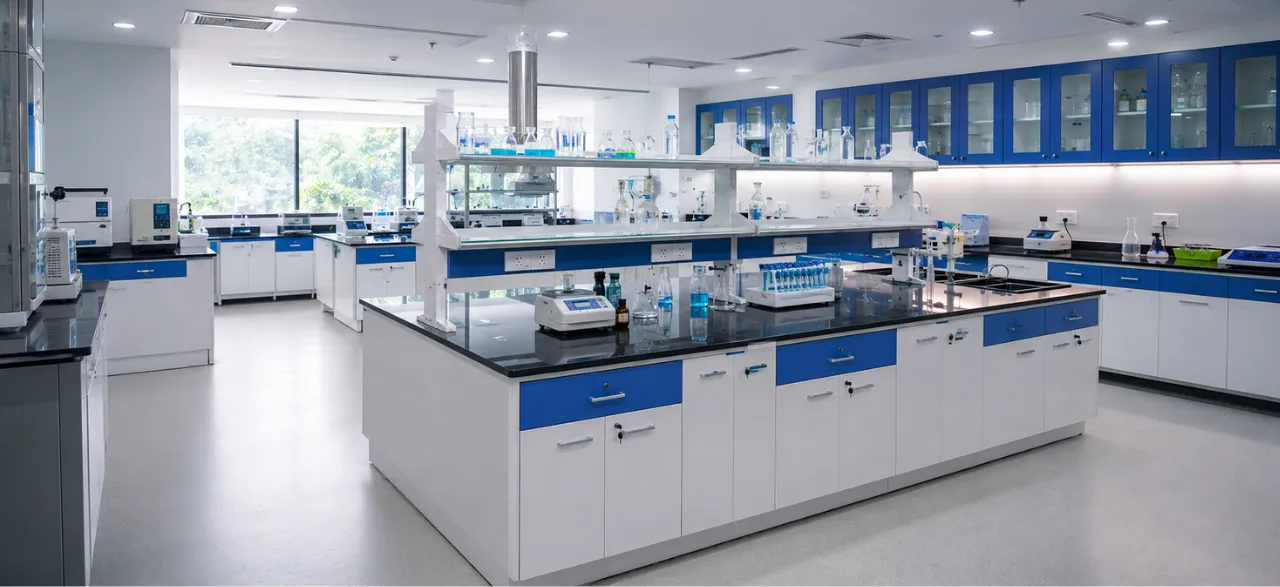
Modern laboratories in India are changing rapidly. In 2026, laboratory design is no longer limited to installing benches, cabinets, and instruments. Today’s laboratories are being planned as integrated environments where workflow, safety, digital monitoring, compliance, utilities, and modular infrastructure work together to improve efficiency and accuracy.
Whether you’re planning a turnkey laboratory setup in India, upgrading pharmaceutical lab design, or improving laboratory infrastructure in India, modern planning focuses on creating safer, smarter, and future-ready facilities. With evolving lab safety standards, stricter regulatory requirements, and increasing demand for flexible laboratory spaces, organisations must design laboratories that support both current operations and future expansion.
This guide explains the biggest laboratory trends shaping Indian labs in 2026, including smart laboratory technologies, modular laboratory furniture, compliance-driven planning, and integrated turnkey solutions. It also explores how choosing an experienced lab furniture manufacturer can help laboratories improve productivity, simplify compliance, and build sustainable research environments.
What’s Bringing About This Evolution in Indian Labs?
The discussion on laboratory infrastructure in India is evolving due to changing roles and responsibilities of laboratories. The way research is conducted, analysis is carried out, and quality control processes work have been evolving with time.
Also, new regulatory guidelines are playing their part in this. Revised Schedule M came into force for pharmaceutical manufacturers having turnover less than ₹250 crore from 1 January 2026, after being implemented by larger manufacturers. The revision includes not only good manufacturing practices but also the criteria concerning premises, plant, equipment, and quality management systems.
So, what does the evolving lab mean?
“A modern lab is not simply more automated. It is easier to monitor, safer to operate, simpler to maintain, and better prepared for change.”
From Individual Devices to Integrated Smart Laboratories
For a long period of time, many laboratories were introducing various technologies individually. Each piece was equipped with its own computer, data system, servicing schedule, and operational process. This way of doing things complicates the process with the expansion of the laboratory.
Smart laboratories combine all those components more efficiently. A Laboratory Information Management System may be used to monitor sample collection and analysis. Sensors may track environmental parameters of the lab. Equipment data can be used for timely calibration and servicing. Restrictions can be placed on entering particular areas.
Good practices for lab safety standards and quality control laboratories according to WHO include data control, equipment qualification, laboratory information systems, risk management, and a continuity plan. It is the system that provides the reliability of the test, rather than just the device.
| Earlier Approach | Smarter 2026 Approach | Day-to-Day Benefit |
|---|---|---|
| Samples recorded manually | Digital sample tracking | Easier traceability with faster access to sample records. |
| Room conditions checked periodically | Continuous environmental monitoring | Deviations are noticed sooner, helping maintain consistent laboratory conditions. |
| Maintenance records kept separately | Connected service and calibration records | Better equipment planning and simplified maintenance management. |
| Power and data added after installation | Services planned with the laboratory layout | Fewer cables, fewer temporary fixes, and a safer, more efficient workspace. |
Technology also impacts the physical space. While a computer-based system requires screens, network points, backups of power, secured access to data, and space to allow technicians to manage equipment, effective laboratory design takes this into account at the beginning of the process, not the end after the furniture has been procured.
Safe Design Begins Before the Furniture Arrives
Safety issues are frequently attributed to poor judgment. Sometimes this is deserved, but poor lab design may actually create problems regarding safe practices.
Think of a chemical cabinet situated far away from the work bench. Workers will likely begin to store commonly used containers on the bench. Install a fume hood close to a door where there is traffic and airflow may be compromised. Provide too little space around an emergency shower, and access will become limited.
That is why it is necessary to consider the recommendations for lab safety standards and risk assessment right from the start.
The questions to be considered prior to making the final arrangement include:
- What processes generate smoke, aerosol, heat, or spillages?
- Where will the incompatible chemicals be kept?
- Will it be possible to get the emergency equipment without crossing the area of potential hazard?
- How will the samples come into and leave the laboratory?
- Where will the segregation of the waste materials take place?
- Will it be possible for maintenance personnel to approach the service lines?
Designing Pharmaceutical Labs Based on Compliance
Pharmaceutical lab design must be able to provide the evidence. When the facility is inspected, one cannot say that the process is controlled; all the documents, conditions in the laboratory, history of the instrumentation, and material flows must prove it.
This means that the design will have some very practical consequences.
The sample receipt area will minimise the possibilities of error occurrence. The reagents will require appropriate storage; retained samples will need to be identifiable and safe. The instrumentation will need a stable supply and adequate space, as well as accessibility for calibration or repair.
| Compliance Need | Practical Design Response |
|---|---|
| Reduce sample mix-ups | Separate receipt, preparation, and testing areas |
| Maintain room conditions | Plan HVAC and monitoring points around the process |
| Support equipment qualification | Provide stable utilities and service access |
| Control reagents and samples | Use labelled, application-specific storage |
| Protect records and data | Plan secure physical and digital record areas |
| Manage cleaning and maintenance | Leave accessible surfaces and service routes |
Modular Infrastructure Is Replacing Rigid Layouts
When an experiment laboratory is designed around one fixed process, costs can quickly start to mount. A piece of equipment gets replaced by a bigger one. A new test procedure requires an additional workstation. Automation is introduced. And suddenly all these fixed benches and sealed utilities get in the way.
This is where modular laboratory infrastructure in India is becoming more popular, such as:
- Workbenches that allow reconfiguration
- Transportable or hung storage
- Adjustable shelves
- Accessible utilities spines
- Replaceable work surfaces
- Furniture capable of accommodating equipment changes
Modularity does not mean temporariness. A properly designed system will maintain its structural integrity while each element will be serviceable and movable.
In this regard, laboratory furniture manufacturing is crucial. Workbench parameters, material, weight, storage, utilities, and accessibility need to be taken into account at once and not separately.
Why Turnkey Laboratory Setup is Becoming Popular in India
A laboratory construction project involves architecture, electricals, HVAC, plumbing, gases, safety, furniture, and instrument installation. With each individual package being taken care of separately, there is always going to be conflict on site.
A plug can end up behind the cabinetry. The drain connection can be at variance with the placement of the sink. The fume hood can come when the exhaust system isn’t ready yet. All of these are common occurrences, but all of these cost time and money.
A typical turnkey laboratory setup in India will always involve a coordinated process, which includes:
- Site survey and requirement study
- Workflow and risk assessment
- Layout and utilities planning
- Furniture and equipment coordination
- Civil, electrical, HVAC, plumbing, and gas installation
- Installation and testing
- Documenting and training
| Multiple-vendor Execution | Turnkey Execution |
|---|---|
| Decisions are split across contractors | Work is coordinated through one project plan |
| Service clashes may appear during installation | Utilities are reviewed with furniture and equipment |
| Responsibility can become unclear | A central team manages coordination |
| Handover documents arrive separately | Testing and documentation are consolidated |
In this regard, experienced lab furniture manufacturers can provide laboratory planning, design, delivery, professional installation, and turnkey implementation for projects.
Build Smarter Pharma Labs With Santech
Choose a lab furniture manufacturer for safer, compliant laboratory infrastructure.
Compliance Isn’t Just Purchasing Certified Equipment
An equipment item that is compliant within an uncontrolled room setting does not guarantee a compliant lab.
The entire operational environment counts. It is important for equipment to be installed, qualified when necessary, calibrated, maintained, and used by qualified operators. The environment needs to be monitored. The waste path should be functional. Any change in layout, utility, or equipment needs to be assessed first.
Each laboratory will have its own framework as well. There isn’t one certificate that works for all labs.
| Laboratory Type | Frameworks Commonly Reviewed |
|---|---|
| Testing and calibration laboratory | ISO/IEC 17025 through NABL |
| Medical testing laboratory | ISO 15189 through NABL |
| Pharmaceutical manufacturing or QC | Revised Schedule M and relevant WHO practices |
| Biomedical or containment laboratory | ICMR and WHO biosafety guidance |
| Biomedical waste-generating laboratory | CPCB rules and state authorisation |
These frameworks should be reviewed with qualified regulatory, safety, engineering, and laboratory professionals according to the project’s actual scope.
What Should Labs Focus on While Improving in 2026?
Upgrading doesn’t necessarily have to start with acquiring new equipment; usually, it is more effective to first find out where the existing layout poses problems.
The review should involve:
- Charting sample flows, personnel flows, and waste flows
- Assessing equipment and utility demands
- Evaluating chemical and biological hazards
- Choosing appropriate worktop materials
- Looking for maintenance barriers
- Inspecting emergency exits and ventilation system efficiency
- Allocating room for future equipment
- Documenting and validating along with the build-out
- Training end users after commissioning
It will prevent a frequent error – improving the visual look of a laboratory but leaving its workflow untouched.
Keep Exploring Smarter Laboratory Ideas
Discover useful guidance for planning stronger laboratory environments.
The Bottom Line
In 2026, the most successful Indian laboratories will not simply be those equipped with the latest technology. They will be facilities where laboratory design, digital systems, infrastructure, safety, and compliance work together to create a seamless and efficient working environment. A well-planned laboratory reduces operational challenges, improves workflow, enhances safety, and supports long-term growth.
Modern laboratory planning goes beyond selecting equipment or furniture. It focuses on creating adaptable spaces with integrated utilities, smart monitoring, modular laboratory furniture, and compliance-ready infrastructure. Whether establishing a new facility or upgrading an existing one, investing in a Turnkey Laboratory solution ensures every aspect of the project is planned, coordinated, and delivered efficiently.
At Santech Labs, we provide complete turnkey laboratory solutions that combine laboratory furniture, utilities, safety systems, and compliance into a single, streamlined process. Our objective is to help organisations build future-ready laboratories that meet today’s operational needs while remaining flexible for tomorrow’s innovations.