
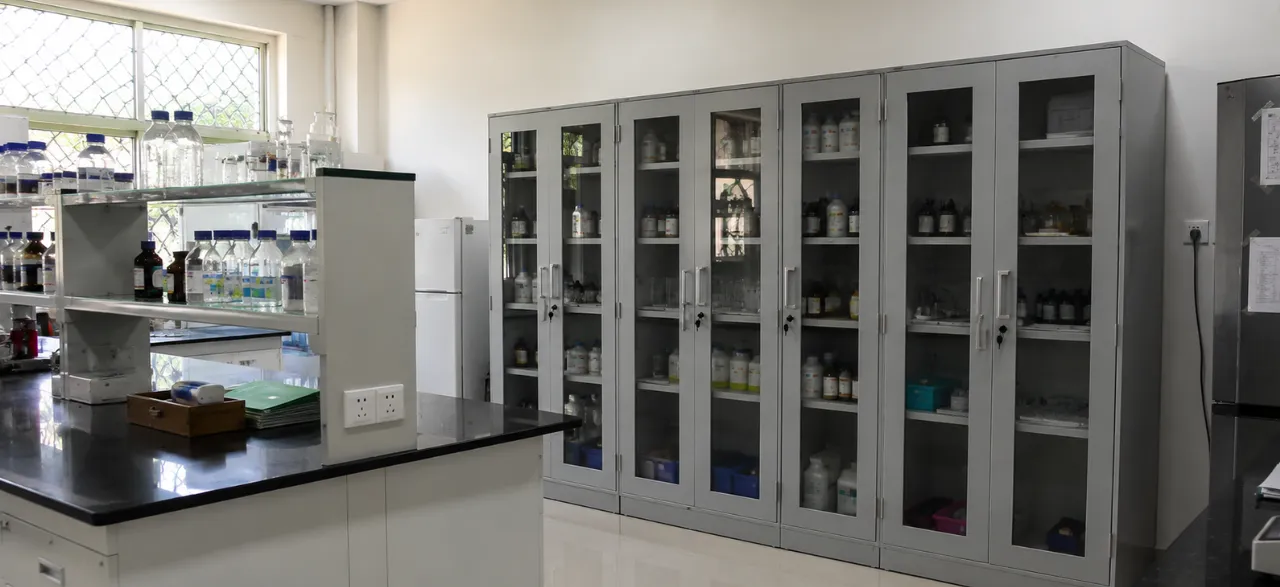
Choosing between custom laboratory storage cabinets and standard laboratory storage cabinets depends on your laboratory’s space, storage requirements, workflow, budget, and future needs. Standard cabinets are ideal for predictable, repetitive storage and faster procurement, while custom cabinets provide greater flexibility for unusual dimensions, specialised equipment, and specific laboratory requirements. Modular lab cabinets offer a practical middle ground by allowing storage systems to be reconfigured or expanded as the laboratory evolves. This guide compares custom, standard, and modular options to help you choose the right solution for your lab. Need help planning your laboratory storage? Consult Santech Labs for customised laboratory furniture solutions designed around your space and workflow.
Custom vs Standard Laboratory Storage Cabinets Serve Different Purposes
Here is the practical difference:
| Requirement | Custom Laboratory Storage Cabinets | Standard Laboratory Storage Cabinets |
|---|---|---|
| Irregular room dimensions | Excellent fit | Limited |
| Faster procurement | Usually slower | Usually faster |
| Internal configuration | Highly flexible | Predetermined |
| Initial cost | Usually higher | Generally lower |
| Special equipment storage | Easier to accommodate | May require compromise |
| Future reconfiguration | Depends on design | Depends on system |
| Visual consistency | Can be matched to the complete laboratory | Easier with standard ranges |
| Unusual storage volume | Can be designed around specific requirements | Limited to available sizes |
The decision becomes much simpler once the laboratory identifies where standardisation is useful and where it creates a compromise.
Why It’s Worth Choosing Custom Laboratory Storage Cabinets
Imagine there is a gap between a bench and a wall in the laboratory, which is too narrow to fit a regular cabinet that has a width of 600 mm, and at the same time too large to use a smaller one. In this case, there is no other option but to use custom laboratory storage cabinets.
However, peculiar dimensions are not the only reason for customising.
If the laboratory deals with microorganisms, there can be special requirements for the cabinetry. If there is any kind of pharmaceutical activity in the lab, the cabinets must be made of stainless steel. There can be special requirements for the load capacity of the cabinet or for the internal arrangement.
Custom laboratory storage cabinets should be considered in cases when:
- There are columns or peculiarities in the arrangement of the laboratory room;
- Special instruments, containers, or consumables need special compartments;
- Cabinets of special dimensions are required by the benches;
- Special locking arrangements for controlled and restricted access storage are needed;
- The laboratory prefers furniture in a built-for-purpose facility.
When Standard Laboratory Storage Cabinets are Superior
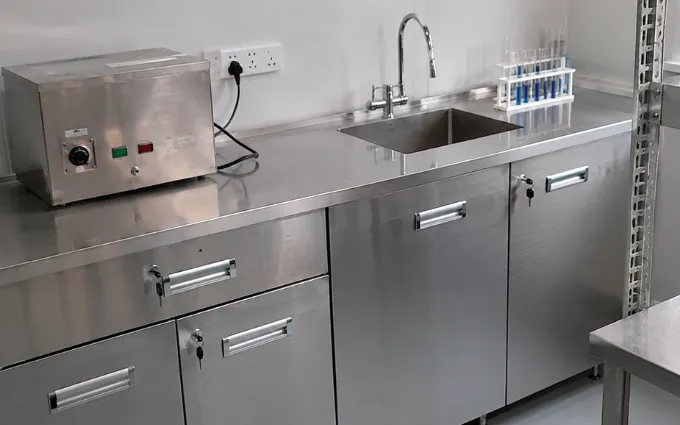
Standard laboratory storage cabinets are more advantageous in situations where the storage required is straightforward, repetitive, and does not involve unique dimensions or setups.
These are particularly useful for:
- Equipment that are common to a laboratory such as gloves, glassware, and other tools
- Workstations which involve the repetition of the same under-bench storage in different benches
- Teaching laboratories which have a standard layout and consistent storage requirements
- Quicker replacements since standard sizes are more easily reproducible or scalable in the future
For instance, the laboratory set up of a university may benefit more from the use of standard rather than customised cabinets.
f you need more guidance on selecting the right cabinet for your laboratory, see our guide to choosing the right science lab storage cabinets.
Note: Standard should mean appropriate and repeatable, not simply whatever size is readily available..
Modular Lab Cabinets Provide Flexibility
A storage cabinet doesn’t have to be either fully customised or standard. Modular lab cabinets are another option that use standardised units that can be combined or rearranged as the laboratory changes.
This approach is effective due to the following reasons:
| Modular Lab Cabinet Feature | How It Benefits the Laboratory |
|---|---|
| Variety of configurations | Base, wall, tall, drawer, and under-bench modules can be combined to suit different storage requirements. |
| Reconfigurability | Cabinets can be rearranged, replaced, or relocated when laboratory workflows change. |
| Future adaptability | Additional modules can be introduced as storage requirements or laboratory operations expand. |
| Space optimisation | Different cabinet modules help make better use of available wall, under-bench, and vertical storage space. |
| Consistent design | A common cabinet system creates a consistent appearance across different laboratory rooms. |
| Scalability | Storage capacity can be increased by adding compatible modules instead of replacing the complete furniture system. |
| Easy replacement | Individual modules can be replaced when damaged or when a different storage function is required. |
| Workflow flexibility | Cabinet arrangements can be adapted to support changing equipment positions, work processes, and storage access needs. |
| Simplified maintenance | Standardised components can make maintenance, servicing, and replacement easier when compatible spare parts are available. |
| Multi-laboratory consistency | The same modular cabinet system can be used across multiple laboratories while allowing each room to have a different configuration. |
Do Custom Cabinets Always Cost More?
Custom laboratory storage cabinets generally cost more because of engineering work, measurements, drawings, special materials, and the manufacturing of a project.
However, the purchase price is just one component in the equation.
For example, a laboratory may save some money by purchasing several standard cabinets only to find out that these do not fill the empty space along two walls, and additional cabinets will need to be purchased in other parts of the laboratory, thus causing problems with traffic or bench space.
Another example may be when the laboratory spends more money on custom cabinets for regular supplies.
A more realistic approach would be:
This will give an idea of value beyond the cabinet price.
Hybrid Storage Solution Often Proves Best Approach

Labs typically don’t need to select only one solution for the whole facility. For educational institutions, this approach can be particularly useful when planning an efficient education lab setup, where standardised storage may be required across multiple student workstations.
Use standard laboratory storage cabinets when the need is repetitive. Use custom laboratory storage cabinets when the dimensions of the room, the equipment, the safety considerations, or workflow justify it. Then use modular lab cabinets in those rooms that will probably change in the future.
Examples might be:
- Standard wall cabinets for consumables;
- Customised tall cabinets near structural columns;
- Specialised cabinets for particular chemical storage needs;
- Modular under-bench cabinets for research spaces that may change in the future.
What Should You Ask Your Storage Cabinet Manufacturer?
Before accepting the quotation, go beyond the dimensions in the catalogue.
How do they calculate load capacity? Which types of materials are suitable for your laboratory setup? Are shelves adjustable? How will damaged parts be replaced? Can the cabinets be reconfigured in case you expand your laboratory?
Most importantly, involve the supplier before the furniture planning process is finalised.
A professional lab storage cabinet manufacturer should assess your laboratory’s space, storage requirements, equipment, workflow, and future needs rather than simply supplying cabinets based on a quantity list.
How to Choose the Right Laboratory Storage Cabinet for Your Lab
| Laboratory Requirement | Recommended Cabinet | Why? |
|---|---|---|
| Predictable and repetitive storage | Standard Cabinets | Provides consistent configurations and can simplify procurement and replacement. |
| Irregular room dimensions | Custom Cabinets | Can be designed to use difficult spaces and accommodate specific dimensions. |
| Special equipment or storage requirements | Custom Cabinets | Internal layouts, dimensions, materials, and access features can be tailored to the requirement. |
| Laboratory layout may change | Modular Cabinets | Modules can provide greater flexibility for future rearrangement and expansion. |
| Need for repeated workstation storage | Standard Cabinets | Repeatable cabinet sizes help maintain consistency across multiple workstations. |
| Need for long-term flexibility | Modular Cabinets | Allows storage capacity and configurations to evolve with laboratory requirements. |
| Combination of different requirements | Hybrid Solution | Combining standard, custom, and modular cabinets can provide a practical balance of cost, fit, and flexibility. |
Conclusion
Choosing between custom laboratory storage cabinets, standard cabinets, and modular lab cabinets depends on what your laboratory actually needs. Standard cabinets are a practical choice for regular and repetitive storage, while custom cabinets are better suited to unusual spaces, specialised equipment, and specific storage requirements. Modular cabinets are useful when you expect the laboratory layout or storage needs to change over time.
Instead of focusing only on the initial price, consider the cabinet’s fit, storage capacity, accessibility, durability, maintenance, and future flexibility. A good storage solution should make better use of your laboratory space and support the way your team works.
If you are planning a new laboratory or upgrading an existing one, Santech Labs can help you select the right storage solution for your requirements. As experienced lab furniture manufacturers, we provide customised laboratory furniture designed around your space, workflow, equipment, and storage needs.
Need the right storage solution for your laboratory? Contact Santech Labs today to discuss your project.