
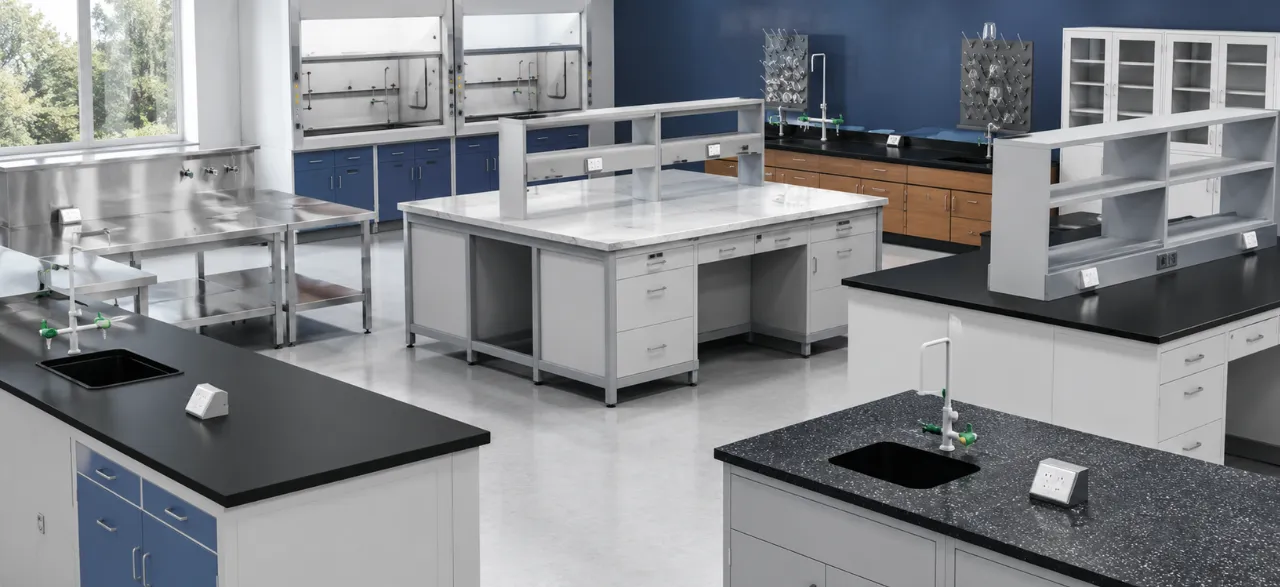
A laboratory workbench is a purpose designed workstation used for laboratory testing, research, sample preparation and equipment handling. The right workbench provides a stable working surface while supporting safe workflow, equipment placement, storage and everyday laboratory activities.
Choosing a laboratory workbench depends on factors such as the type of laboratory work, equipment load, available space, worktop material, cleaning requirements and the level of flexibility required. Common systems include C-Frame, D-Frame and Plinth laboratory workbenches, while worktop materials can include epoxy resin, phenolic resin, stainless steel, ceramic and polypropylene.
In this guide, we explain the types of laboratory workbenches, laboratory workbench materials, standard dimensions and key factors to consider when choosing the right lab workbench for your application.
What Is a Laboratory Workbench?
A laboratory workbench is more than a flat working surface. It is a purpose-designed workstation built around the practical requirements of laboratory work.
Key features of a laboratory workbench include:
- Purpose-built work surface: Provides a stable area for testing, sample preparation, experiments and equipment operation.
- Strong supporting structure: Designed to support laboratory instruments and withstand regular daily use.
- Application-specific worktops: Materials such as epoxy resin, phenolic resin, stainless steel, ceramic and polypropylene can be selected based on chemical, heat and cleaning requirements.
- Integrated storage: Drawers, cabinets and shelves can be incorporated to keep equipment, samples and laboratory supplies organised.
- Utility integration: Depending on the laboratory layout, workbenches can accommodate electrical points, water, gas and other service connections.
- Different structural designs: C-frame, D-frame, plinth-based, wall-mounted, island and mobile configurations are available for different laboratory environments.
- Ergonomic working height: Proper dimensions help users work comfortably while maintaining efficient access to equipment and materials.
- Adaptable layouts: Modular laboratory workbenches can be reconfigured when equipment, workflow or laboratory requirements change.
- Equipment support: The workbench can be planned according to the size, weight and operating requirements of laboratory instruments.
- Laboratory-specific durability: Construction and materials are selected to handle the level of chemical exposure, moisture, heat, cleaning and general wear expected in the laboratory.
Ultimately, the right laboratory workbench should be selected as part of the overall laboratory layout, considering workflow, equipment, storage, utilities, safety and future expansion rather than choosing a bench based on appearance alone.
Why Is a Laboratory Workbench Important?
A laboratory workbench is important because it provides a stable, durable and practical workspace for laboratory activities. Unlike ordinary furniture, a laboratory workbench is designed around the requirements of testing, research, sample preparation, equipment handling and other laboratory tasks. For laboratories looking for adaptable workstation solutions, Flexible Modular Laboratory Benching can provide greater flexibility when equipment, workflow or space requirements change.
The right workbench can improve workflow, equipment stability, safety, storage and space utilisation while making everyday laboratory work more comfortable and efficient.
| Laboratory Workbench Material | Key Properties | Best Suited For |
|---|---|---|
| Epoxy Resin | Chemical, heat and moisture resistant; durable and non-porous | Chemistry, pharmaceutical and demanding laboratories |
| Phenolic Resin | Lightweight, durable and resistant to many chemicals | General laboratory applications |
| Stainless Steel | Hygienic, corrosion-resistant and easy to clean | Medical, research and clean environments |
| Ceramic | High resistance to heat, chemicals and scratching | High-temperature and demanding applications |
| Polypropylene | Strong resistance to many aggressive chemicals | Chemical handling areas |
| Chemical-Resistant Laminate | Practical, easy to maintain and cost-effective | General and educational laboratories |
What Are the Different Types of Laboratory Workbenches?
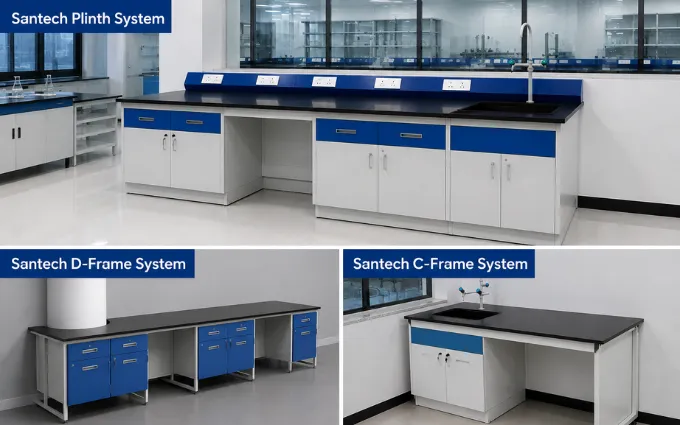
The lab workbench types generally depend on the support system beneath the work surface. In modular lab design, there is considerable influence exerted by the supporting system in terms of the efficiency of the workbench performance. Workbenches are an essential part of laboratory furniture and are designed to support various scientific, research, and testing activities. Different types of laboratory furniture serve specific functions, helping laboratories maintain safety, organization, and operational efficiency.
Here are some of the most common supporting systems:
C Frame System
The C Frame system is a cantilever-based support system, whereby the work surface is supported independently of any fixed base. This results in enhanced adaptability and improved access to the undersides. It is therefore very effective in situations where future changes to the room might be anticipated.
In many situations, this system has proven ideal in instances where there is a need for room openness, maintenance accessibility, and cleaner undersides.
D Frame System
The D Frame System is designed to be durable and flexible. It provides stability and the ability to optimise the use of space while performing well in challenging laboratory settings. This is usually provided either in mild steel or stainless steel 304, depending on the surface finish required for regular use in laboratories.
This makes it a good option for laboratories with heavy machinery or busy workloads. Where stability becomes a priority, this system helps in creating a feeling of solidity in the bench.
Plinth System
The Plinth System is usually used if one needs a permanent solution and a good base for their furniture. It provides a firm and flat surface, and it is effective in reducing vibrations while working.
If you own a lab where you need stability and permanency, the plinth system could be an ideal choice.
Which Laboratory Workbench Material Is Best?
There is no single laboratory workbench material that is best for every application. The right choice depends on factors such as chemical exposure, heat, moisture, cleaning requirements, equipment and the expected level of daily use.
Common laboratory workbench materials include:
- Epoxy Resin: A durable, non-porous option suited to laboratories exposed to chemicals, heat and frequent cleaning.
- Phenolic Resin: A lightweight option that offers good chemical resistance for general laboratory applications.
- Stainless Steel: Suitable where hygiene, corrosion resistance and easy cleaning are important.
- Ceramic: A suitable choice for applications requiring strong resistance to heat, chemicals and scratching.
- Polypropylene: Particularly useful for laboratory areas where aggressive chemical resistance is required.
- Chemical-Resistant Laminate: A practical and cost-effective option for general laboratory applications with moderate chemical exposure.
The best worktop should therefore be selected according to the laboratory’s specific working conditions rather than based on material alone.
Laboratory Workbench Material Comparison
| Laboratory Workbench Material | Key Properties | Best Suited For |
|---|---|---|
| Epoxy Resin | Chemical, heat and moisture resistant; durable and non-porous | Chemistry, pharmaceutical and demanding laboratories |
| Phenolic Resin | Lightweight, durable and resistant to many chemicals | General laboratory applications |
| Stainless Steel | Hygienic, corrosion-resistant and easy to clean | Medical, research and clean environments |
| Ceramic | High resistance to heat, chemicals and scratching | High-temperature and demanding applications |
| Polypropylene | Strong resistance to many aggressive chemicals | Chemical handling areas |
| Chemical-Resistant Laminate | Practical, easy to maintain and cost-effective | General and educational laboratories |
What Are the Standard Laboratory Workbench Dimensions?
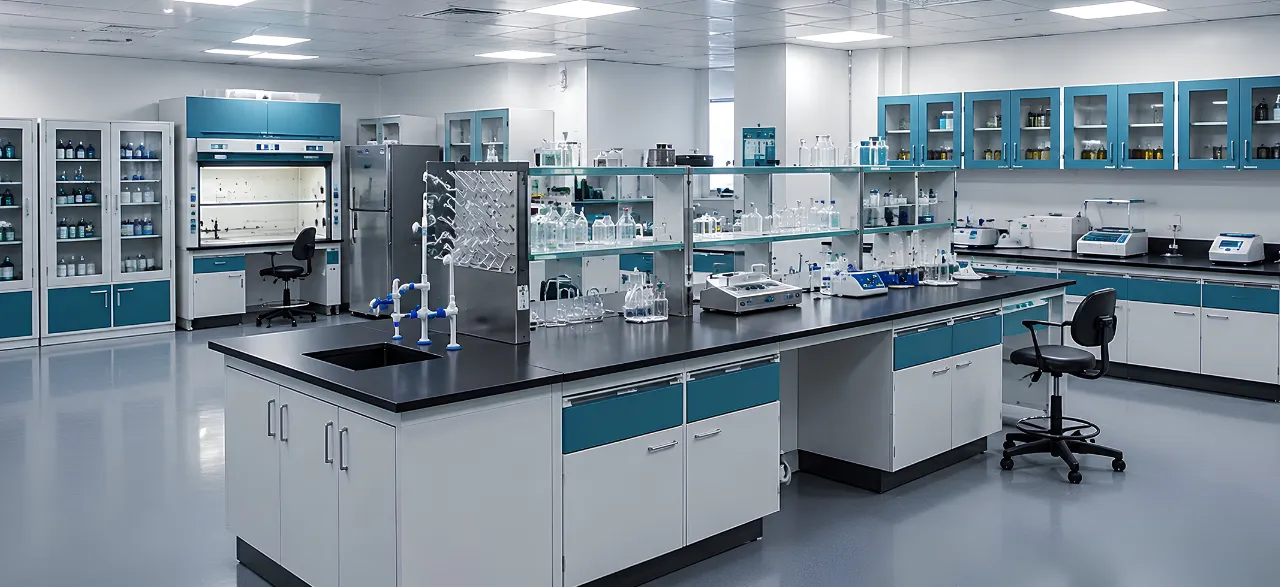
Laboratory workbench dimensions should be planned around the user’s working position, equipment size, available floor space and laboratory workflow. There is no single dimension that suits every laboratory, but certain ranges are commonly used when planning laboratory workstations. Proper dimensions should also be considered as part of an efficient lab layout, helping ensure comfortable movement, suitable equipment placement and effective use of available space.
1. Workbench Height
A laboratory workbench is commonly designed at around 750–900 mm in height, depending on whether the workstation is intended for seated or standing work.
- Seated work: approximately 750–800 mm
- General standing work: approximately 850–900 mm
- Specialised applications: height may be adjusted according to equipment and ergonomic requirements
The correct height should allow users to work comfortably without excessive bending or reaching.
2. Worktop Depth
A typical laboratory worktop may be around 600–750 mm deep.
Greater depth can be useful when large instruments need to be placed on the bench or when additional working space is required. However, excessive depth can make equipment at the rear difficult to access.
3. Workbench Length
Laboratory workbench length is generally determined by the available wall or floor space and the equipment that needs to be accommodated.
Common configurations may include:
- 1200 mm: Compact workstation
- 1500 mm: General-purpose laboratory work
- 1800 mm: Larger equipment or shared workstation
- 2400 mm and above: Extended work areas and multiple users
Rather than selecting a standard length, the bench should be sized according to equipment placement, user requirements and workflow.
4. Legroom and Working Clearance
Adequate clearance beneath the worktop is important for comfortable seated work and accessibility. Pedestal units, cabinets and service connections should be positioned so they do not unnecessarily restrict the user’s legroom.
For equipment-heavy workstations, sufficient clearance should also be maintained around instruments to allow operation, maintenance and servicing.
5. Aisle Space
Aisle space should allow laboratory personnel to move safely between workbenches, equipment and storage areas.
The required clearance depends on the number of users, equipment arrangement, doors, emergency routes and whether the laboratory uses single-sided or island workbenches. The laboratory layout should therefore be planned around actual movement and workflow rather than simply maximising the number of benches.
How Should a Laboratory Workbench Be Tailored to the Lab?
A laboratory workbench should be selected according to the type of work performed, equipment used and conditions within the laboratory. There is no single workbench configuration that suits every application.
For example, a chemistry laboratory may require a durable worktop with strong chemical resistance, while a pharmaceutical or quality-control laboratory may place greater emphasis on cleanability, organised workflow and equipment placement. In such environments, choosing suitable pharmaceutical laboratory furniture can help support the specific workflow, equipment and operational requirements of the laboratory. Educational laboratories may prioritise durability, storage and efficient use of space.
Key factors to consider when tailoring a laboratory workbench include:
- Type of laboratory work: Consider whether the bench will be used for testing, research, sample preparation, teaching or equipment handling.
- Equipment requirements: Check the size, weight and operating requirements of instruments that will be placed on the workbench.
- Worktop material: Select a surface according to chemical exposure, heat, moisture, cleaning frequency and the type of work performed.
- Storage needs: Include drawers, cabinets or pedestals where frequently used equipment, samples and laboratory supplies need to be stored.
- Available space: Plan the bench dimensions and position around room size, equipment placement and user movement.
- Utilities: Consider electrical points and other required laboratory services during the workstation planning stage.
- Future requirements: Allow sufficient flexibility for changes in equipment, workflow or laboratory expansion.
At Santech Labs, laboratory workbench planning can be considered as part of the wider laboratory layout, helping the workstation work effectively with equipment, storage, utilities and user movement.
How To Pick The Right Lab Bench
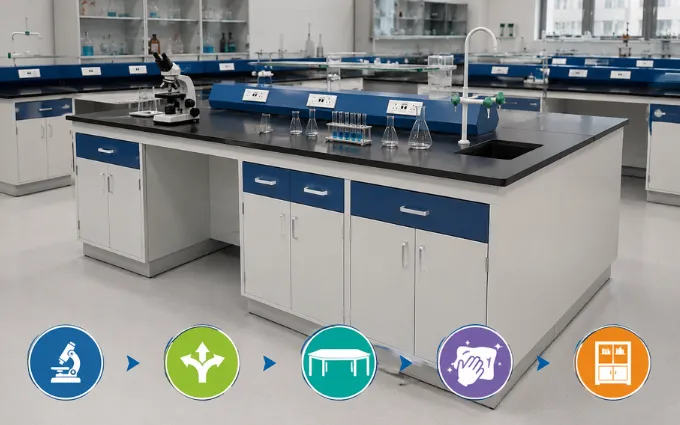
Not all laboratory workbenches need the same configuration. The right bench should match the type of laboratory work, available space, equipment requirements and future needs. This is why it is better to consider the overall workbench system before choosing the worktop material, storage and design details.
Here are the key factors to consider when choosing a laboratory workbench:
- Identify the laboratory work: Determine whether the bench will be used for testing, research, sample preparation, teaching or equipment handling.
- Consider flexibility or rigidity: Decide whether your laboratory needs a flexible modular arrangement or a more fixed and stable workstation.
- Choose the appropriate framework: Select a framework such as a C-Frame, D-Frame or Plinth system according to the equipment, layout and level of stability required.
- Select the right worktop material: Consider chemical exposure, heat, moisture, cleaning frequency and daily laboratory use before selecting the work surface.
- Check the dimensions: Make sure the workbench height, depth and length provide enough space for both users and laboratory equipment.
- Plan storage and utilities: Consider cabinets, drawers, pedestals and required utility connections as part of the overall workstation design.
- Consider future requirements: If equipment, processes or laboratory layouts may change, choose a configuration that can accommodate future modifications.
By considering these factors before purchasing, you can choose a laboratory workbench based on function, durability, safety and workflow rather than aesthetics alone.
Why The Manufacturer Matters
Choosing the right laboratory furniture manufacturer in India can make a significant difference to the functionality, safety and long-term performance of a laboratory. A reliable manufacturer should consider the laboratory’s requirements, equipment, workflow, available space and future expansion plans. Understanding the laboratory setup cost in India is also important when planning the overall project budget, as furniture, storage, utilities, installation and other infrastructure requirements can affect the final cost.
- Laboratory requirements: Furniture should be planned according to the type of laboratory work, equipment and daily activities.
- Workbench selection: The manufacturer should help select the appropriate C-Frame, D-Frame or Plinth system based on the required stability and layout.
- Worktop materials: Materials should be selected according to chemical exposure, heat, moisture, cleaning requirements and application.
- Equipment integration: Workbenches should provide suitable space and support for laboratory equipment and instruments.
- Storage planning: Cabinets, drawers and storage solutions should be positioned to keep frequently used materials accessible without disrupting workflow.
- Utility integration: Electrical, plumbing and other service requirements should be considered during the furniture planning stage.
- Space utilisation: Furniture should make effective use of the available floor area while maintaining comfortable movement and working clearances.
- Future flexibility: Modular laboratory furniture can make it easier to modify or expand the laboratory as requirements change.
- Installation support: Proper coordination between manufacturing, delivery and installation helps ensure that the planned laboratory layout is implemented correctly.
Santech Labs provides modular laboratory furniture with planning and installation support, helping laboratories coordinate workbenches, storage, equipment placement and other furniture requirements as part of a complete laboratory setup.
Conclusion
A laboratory workbench is more than a basic working surface it plays an important role in laboratory safety, workflow, equipment placement and day-to-day efficiency. The right workbench should be selected based on the laboratory application, equipment requirements, available space, worktop material, storage needs and future expansion.
C-Frame, D-Frame and Plinth systems offer different structural options, while materials such as epoxy resin, phenolic resin, stainless steel, ceramic and polypropylene can be selected according to the working environment.
Santech Labs provides modular lab furniture manufacturers designed around laboratory requirements, helping businesses and institutions plan practical workbenches, storage and supporting infrastructure. If you are planning a new laboratory or upgrading an existing one, choosing the right laboratory workbench and furniture system can create a safer, more efficient and future-ready workspace.