

The BSL full form in medical and laboratory settings is Biosafety Level, a classification used to describe the containment measures required when working with biological agents. Biosafety levels range from BSL-1 to BSL-4, with each level involving different laboratory practices, safety equipment and facility requirements based on the risks associated with the work.
Understanding biosafety levels is essential for laboratory owners, researchers, healthcare professionals, microbiologists and facility planners. The correct laboratory layout, suitable equipment, appropriate work practices and effective risk assessment all contribute to a safer working environment.
In this guide, Santech Labs explains the four biosafety levels, their applications and the laboratory planning considerations that support safe and efficient operations.
What Is the Full Form of BSL in Medical Terms?
The BSL full form in medical laboratory settings is Biosafety Level. It refers to a system for determining the appropriate containment measures for laboratory activities involving biological materials that may pose risks to people, animals or the environment.
Biosafety levels are commonly used in clinical diagnostic laboratories, microbiology laboratories, biomedical research facilities and public health laboratories.
The required level depends on several factors, including:
- The biological agent being handled.
- The likelihood and consequences of exposure.
- The procedures being performed.
- The potential routes of transmission.
- The safety equipment and laboratory facilities available.
- The training and competence of laboratory personnel.
The US Centers for Disease Control and Prevention (CDC) describes four biosafety levels, from BSL-1 to BSL-4. These levels involve progressively greater containment measures, although the appropriate controls must be determined through a suitable risk assessment.
What Are the Four Biosafety Levels?
The four biosafety levels are BSL-1, BSL-2, BSL-3 and BSL-4. Each level establishes a different combination of laboratory practices, safety equipment and facility controls.
| Biosafety Level | General Risk Profile | Typical Laboratory Activities |
|---|---|---|
| BSL-1 | Low biological risk | Basic teaching and research involving well-characterised agents not known to consistently cause disease in healthy adults |
| BSL-2 | Moderate biological risk | Clinical diagnostic work and research involving biological agents that can cause human disease |
| BSL-3 | Higher containment requirements | Work involving agents that can cause serious or potentially lethal disease, particularly when inhalation exposure is a concern |
| BSL-4 | Highest containment level | Specialised work involving dangerous agents that pose a high individual risk and may cause life-threatening disease |
Note: This table provides a general overview. The required containment measures depend on the specific agent, procedure and applicable guidance.
1. Biosafety Level 1 (BSL-1)
BSL-1 is the basic level of biological containment. It is generally appropriate for educational and research activities involving well-characterised biological agents that are not known to consistently cause disease in healthy adults.
Typical considerations include:
- Standard microbiological practices.
- Appropriate personal protective equipment when required.
- Accessible handwashing facilities.
- Work surfaces that can be cleaned and decontaminated effectively.
- Suitable arrangements for equipment, materials and waste.
BSL-1 laboratories are commonly found in educational institutions and basic research settings.
Laboratory planning consideration: Organised workstations, accessible storage and easy-to-clean surfaces can help support routine laboratory activities. The final arrangement should reflect the experiments, equipment and safety procedures involved.
2. Biosafety Level 2 (BSL-2)
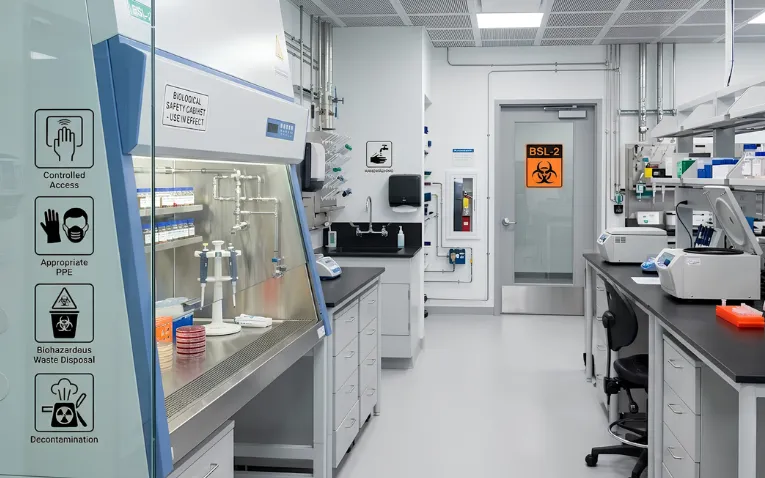
BSL-2 applies to laboratory activities involving biological agents that can cause human disease and require additional precautions beyond basic laboratory practices.
These facilities may include clinical diagnostic laboratories, microbiology laboratories and biomedical research environments.
Important considerations include:
- Controlled access when work involving biological hazards is underway.
- Appropriate personal protective equipment.
- Suitable biological safety cabinets for procedures that may generate infectious aerosols or splashes.
- Safe handling and disposal of biological waste.
- Appropriate decontamination procedures.
- Access to handwashing and other required safety facilities.
Laboratory planning consideration: Workstations, storage units and equipment locations should support safe movement, effective cleaning and the separation of activities where necessary. Biological safety cabinets must be selected and positioned according to the procedures being performed and the relevant installation requirements.
For further guidance, read Santech Labs’ article on laboratory safety tips.
3. Biosafety Level 3 (BSL-3)
BSL-3 is intended for laboratory activities involving agents that can cause serious or potentially lethal disease, particularly when inhalation exposure is a concern.
These laboratories require more stringent containment controls than BSL-1 and BSL-2 facilities.
Key considerations may include:
- Restricted access and controlled entry.
- Appropriate directional airflow and ventilation arrangements.
- Primary containment equipment suited to the work.
- Procedures for decontamination and safe waste management.
- Suitable facility design and maintenance.
- Documented operating procedures and trained personnel.
Work involving Mycobacterium tuberculosis is a recognised example of activity that may require BSL-3 containment, depending on the procedures and applicable risk assessment.
Laboratory planning consideration: BSL-3 projects require coordinated input from biosafety professionals, laboratory designers, engineering specialists and facility operators. Equipment placement, ventilation, service access, cleanability and maintenance must be considered together rather than as separate decisions.
4. Biosafety Level 4 (BSL-4)
BSL-4 is the highest biosafety containment level. It is used for specialised laboratory work involving dangerous agents that pose a high risk of severe or life-threatening disease.
Examples of agents associated with BSL-4 research include Ebola and Marburg viruses.
Depending on the facility and work, controls may include:
- Highly restricted access.
- Specialised primary containment systems.
- Dedicated ventilation and engineering controls.
- Validated decontamination procedures.
- Specialised protective clothing or suit systems.
- Extensive training, maintenance and emergency procedures.
Laboratory planning consideration: BSL-4 facilities require specialist architectural, mechanical, engineering and biosafety expertise. Standard laboratory furniture or a conventional laboratory fit-out cannot, on its own, meet BSL-4 containment requirements.
Why Are Biosafety Levels Important in Laboratory Design?
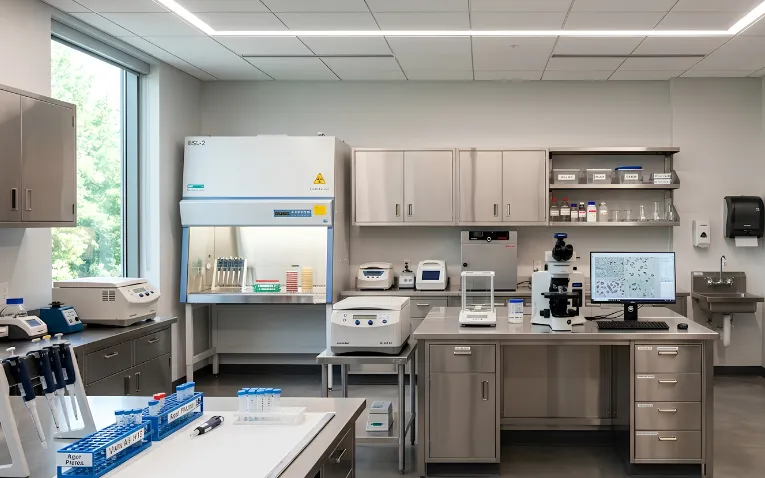
Biosafety levels help laboratories identify the practices, equipment and facility controls needed to manage biological risks. They also influence how laboratory spaces are planned, maintained and operated.
The World Health Organization (WHO) recommends a risk-based approach to laboratory biosafety. This means the facility and its controls should be appropriate to the biological hazards and activities involved.
Important laboratory planning considerations include:
1. Functional layout: Arrange work areas to support the intended workflow and reduce unnecessary movement between activities.
2. Appropriate laboratory furniture: Select workbenches and storage units based on the laboratory’s procedures, chemical compatibility where relevant, cleaning requirements and equipment loads.
3. Equipment placement: Allow suitable access for operation, cleaning, inspection and maintenance. Equipment requiring specialised containment must be selected and installed according to its intended use.
4. Ventilation and utilities: Plan ventilation, electrical connections, water supplies and other services according to the facility’s technical and biosafety requirements.
5. Cleaning and decontamination: Select surfaces and finishes that are compatible with the required cleaning and decontamination methods.
6. Maintenance and operational planning: Ensure the facility can be inspected, serviced and maintained without compromising essential safety controls.
These considerations should be established through coordinated risk assessment and facility planning. Furniture selection is one part of the process, not a substitute for engineering controls, operating procedures or formal biosafety assessment.
For more information, explore Santech Labs’ guide to designing a successful laboratory.
How Are Biosafety Levels Determined?
A biosafety level should not be assigned solely according to the name of a microorganism. The appropriate containment measures depend on the biological agent, the planned activities and the likelihood and consequences of exposure.
A structured assessment generally considers:
- Identify the biological hazards: Establish which agents and biological materials will be handled.
- Review the planned procedures: Consider whether activities could generate aerosols, splashes or other exposure opportunities.
- Evaluate exposure risks: Assess the possible routes of exposure and the potential consequences.
- Identify suitable controls: Determine the required laboratory practices, protective equipment and engineering measures.
- Assess facility requirements: Establish whether the existing laboratory can support the required controls.
- Review and maintain controls: Reassess risks when procedures, equipment or working conditions change.
Laboratory management should consult qualified biosafety professionals and applicable national and institutional requirements before deciding on the necessary containment measures.
The WHO’s Laboratory Biosafety Manual provides further guidance on risk assessment, laboratory design, protective equipment and biosafety management.
How Can Laboratory Furniture Support a Safer Working Environment?
Laboratory furniture contributes to the organisation, usability and maintainability of a laboratory. However, its suitability depends on the laboratory’s intended use and risk assessment.
When planning laboratory furniture, consider:
- Durable work surfaces: Choose materials suitable for the procedures, cleaning agents and decontamination methods involved.
- Appropriate storage: Provide designated storage for equipment, consumables and other materials according to their compatibility and handling requirements.
- Practical workstation layouts: Support safe movement, efficient workflows and access to equipment.
- Maintenance access: Allow technicians to inspect and service workstations and nearby utilities.
- Equipment compatibility: Ensure workbenches can accommodate the dimensions, weight and operating requirements of laboratory equipment.
As experienced laboratory furniture suppliers, Santech Labs provides laboratory furniture solutions for research, educational and industrial laboratory environments. Each furniture specification should be selected according to the project’s requirements, including workflow, durability, cleaning needs and equipment compatibility, rather than assuming that a particular furniture system automatically satisfies a biosafety level.
Conclusion
Planning a laboratory requires careful consideration of biosafety levels, workflow, laboratory furniture, equipment, storage and containment requirements. From BSL-1 teaching laboratories to BSL-4 high-containment facilities, the layout and infrastructure must align with the intended activities, risk assessment and applicable safety guidelines.
As lab furniture manufacturers in India, Santech Labs provides laboratory furniture solutions designed to support efficient workflows, organised workspaces and the practical requirements of educational, research and industrial laboratories.
Planning a new laboratory or upgrading an existing facility? Contact Santech Labs to discuss your laboratory furniture requirements and request a project consultation.
Note: Laboratory furniture alone does not establish biosafety compliance. Biosafety classification and containment requirements must be assessed by qualified professionals in accordance with applicable regulations and guidelines.