
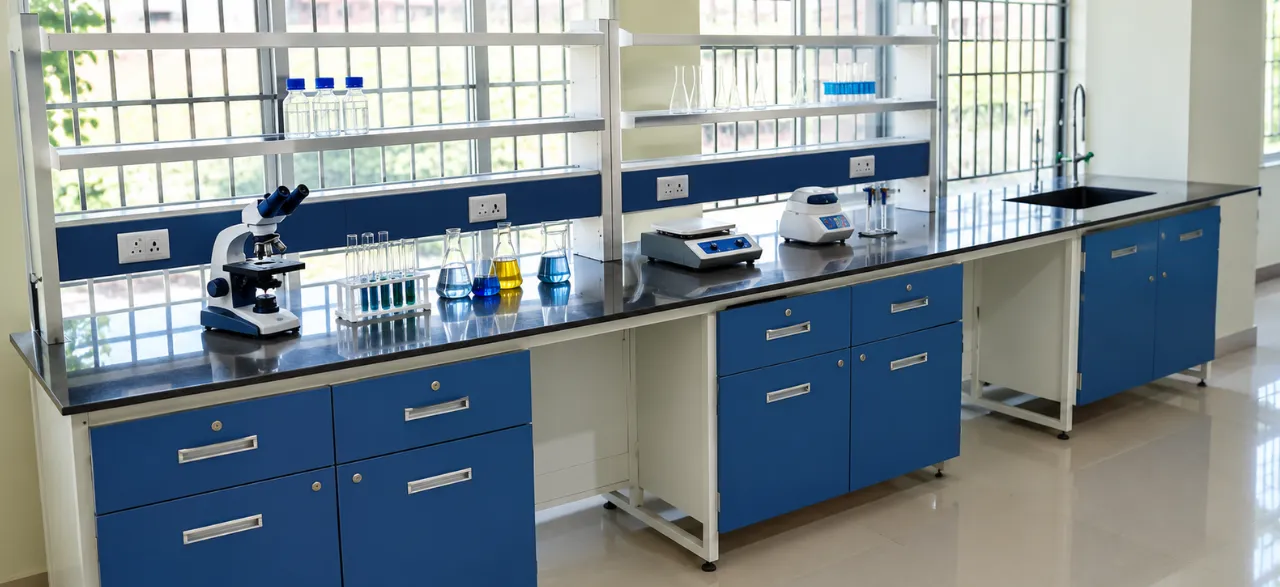
School lab equipment plays an essential role in helping students understand scientific concepts through practical experiments, observation and measurement. From beakers and test tubes to microscopes, balances and measuring instruments, each piece of equipment supports a different aspect of science education.
A well-equipped school laboratory allows students to explore chemistry, physics and biology beyond textbooks. It helps them develop practical skills, improve problem-solving abilities, understand scientific principles and learn safe laboratory practices.
The equipment required depends on the students’ age, curriculum, available space and the experiments conducted in the laboratory. Schools should therefore select suitable apparatus, safety equipment, storage solutions and laboratory furniture according to their teaching requirements.
This guide explains the common school laboratory equipment, its uses, subject-wise requirements and essential safety considerations to help schools plan an effective science laboratory.
What Is School Lab Equipment?
School lab equipment refers to the tools, instruments, apparatus and safety materials used in school science laboratories to conduct experiments, make observations and measure results. Common items include beakers, test tubes, microscopes, measuring cylinders, thermometers and balances for chemistry, physics and biology practicals.
These tools help students understand scientific concepts through hands-on learning. The required equipment depends on the curriculum, students’ age, class size and experiments performed. Schools should also work with a reliable lab furniture supplier to ensure suitable workbenches, storage and laboratory layouts.
What Are the Main Types of School Lab Equipment?
School lab equipment can be grouped into several categories according to its purpose:
- Measuring equipment: Measuring cylinders, thermometers, balances and rulers.
- Laboratory glassware: Beakers, test tubes, flasks and pipettes.
- Observation equipment: Microscopes, magnifying glasses and prepared slides.
- Heating and support equipment: Suitable burners, tripod stands, wire gauze and laboratory clamps.
- Subject-specific apparatus: Equipment used for chemistry, physics and biology experiments.
- Safety equipment: Safety goggles, suitable gloves, laboratory coats and other provisions required for the laboratory’s hazards.
Why Is School Lab Equipment Important?
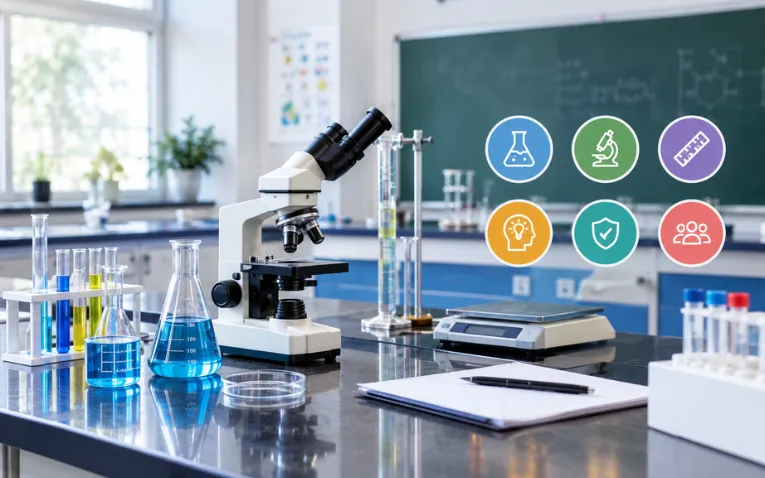
Practical learning helps students connect scientific theories with real-world observations. The right equipment allows them to conduct experiments, record results, compare measurements and understand how scientific principles work.
The main benefits of appropriate laboratory equipment include:
- Practical learning: Students apply classroom concepts through experiments and demonstrations.
- Scientific observation: Microscopes, magnifying glasses and other instruments help students examine objects and specimens.
- Measurement accuracy: Balances, thermometers and measuring cylinders help students collect meaningful experimental data.
- Problem-solving skills: Practical activities encourage students to investigate questions and interpret results.
- Safety awareness: Students learn to handle laboratory materials and equipment responsibly.
- Collaboration: Shared apparatus enables students to work in groups and participate in experiments.
The quantity and specifications of equipment should match the curriculum, class size and level of practical work.
Common School Lab Equipment and Their Uses
Different laboratory instruments serve different purposes. The following school lab equipment list covers common apparatus used in school science laboratories.
1. Beakers
Beakers are cylindrical containers, usually made from laboratory glass or suitable plastic, used to hold, mix and heat liquids when the material is designed for that purpose.
Common uses include:
- Holding liquids during experiments.
- Mixing solutions and preparing materials.
- Observing certain chemical reactions.
- Heating liquids when appropriate for the beaker material.
Beakers are not intended for highly accurate volume measurements. A measuring cylinder or suitable volumetric instrument should be used when greater accuracy is required.
2. Test Tubes and Test Tube Racks
Test tubes are narrow containers used for small-scale experiments, sample preparation and observing reactions. They are commonly found in chemistry and biology laboratories.
Test tube racks keep tubes upright and organised during experiments, while suitable test tube holders allow students to handle tubes when necessary.
| Equipment | Common Use |
|---|---|
| Test tubes | Holding samples and conducting small-scale reactions |
| Test tube racks | Supporting and organising test tubes |
| Test tube holders | Holding tubes during appropriate procedures |
Schools should choose suitable tubes and holders according to the experiment and the materials being handled.
3. Measuring Cylinders
Measuring cylinders are designed to measure liquid volumes more accurately than ordinary beakers. They are available in different capacities to suit various experiments.
Students use them to measure water, prepared solutions and other permitted liquids during practical activities.
For accurate readings, students should place the cylinder on a level surface and follow the appropriate method for reading the liquid level.
4. Laboratory Flasks
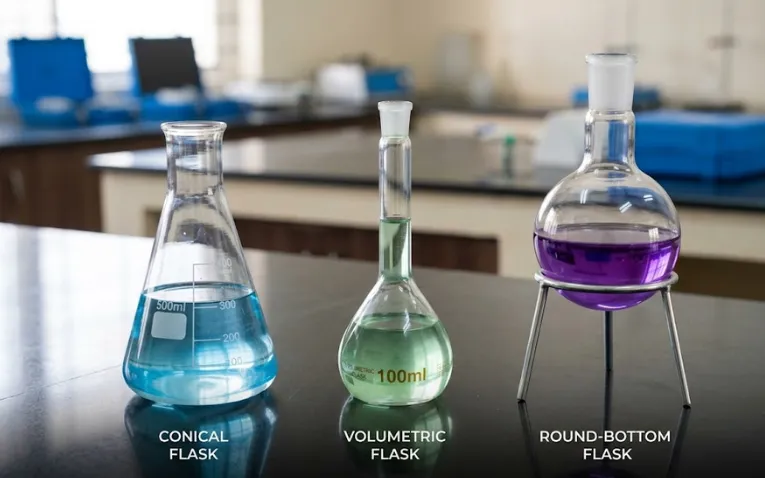
Flasks are common laboratory apparatus used to contain, mix and, where appropriate, heat liquids.
The main types include:
- Conical flasks: Useful for mixing liquids by swirling and for certain chemical experiments.
- Volumetric flasks: Designed to prepare solutions to a specified volume.
- Round-bottom flasks: Used for suitable heating and other procedures when required by the experiment.
Each flask has a particular purpose. Schools should select the type according to the practical activities in their curriculum.
5. Pipettes and Droppers
Pipettes transfer measured volumes of liquid, while droppers are generally used to dispense small amounts of liquid when precise measurement is not required.
These instruments are useful for solution preparation, sample transfer and experiments involving small quantities of liquids.
Students should use the appropriate pipette for each task and must never pipette liquids by mouth.
6. Bunsen Burners and Heating Equipment
Heating equipment is used in selected chemistry experiments and other practical activities that require controlled heating.
Common laboratory heating apparatus includes:
- Bunsen burners.
- Tripod stands.
- Wire gauze.
- Heat-resistant mats.
- Suitable test tube holders.
- Water baths.
- Electric heating devices.
- Fume hoods for controlling exposure to hazardous fumes and vapours
The choice depends on the experiment, student age, laboratory design and school safety procedures. Open flames should only be used when appropriate, with proper supervision and suitable fire-safety provisions.
7. Microscopes
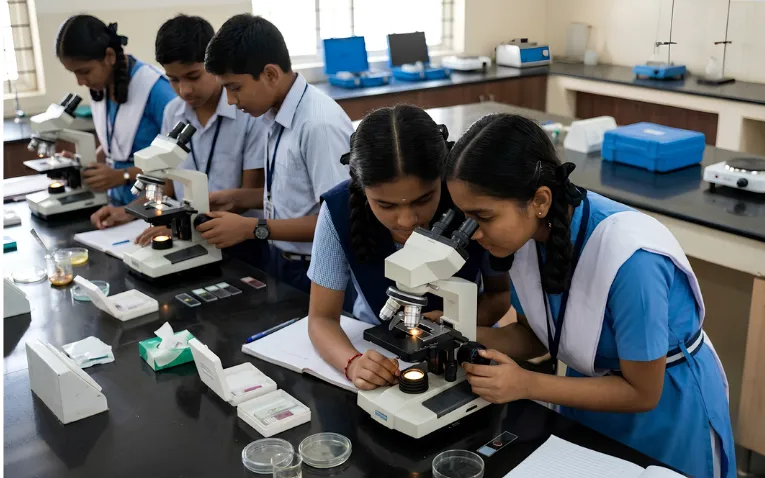
Microscopes magnify small objects that cannot be observed clearly with the unaided eye. They are particularly important in biology practicals.
Common uses include:
- Observing prepared slides.
- Studying plant and animal cells.
- Examining suitable biological specimens.
- Understanding microscopic structures.
Schools should select microscopes according to the curriculum, expected magnification requirements, durability and ease of use.
8. Funnels and Filtration Apparatus
Funnels help students transfer liquids into containers with narrow openings. When used with suitable filter paper, they can also support filtration experiments.
Common filtration apparatus includes:
- Laboratory funnels.
- Filter paper.
- Suitable collection vessels.
- Filter flasks, where required.
These tools help students understand how insoluble solids can be separated from liquids through filtration.
9. Measuring and Observation Instruments
In addition to standard laboratory glassware, students need instruments to measure physical quantities and observe changes.
| Instrument | Primary Function |
|---|---|
| Ruler or metre rule | Measuring length and distance |
| Stopwatch | Measuring time intervals |
| Spring balance | Measuring force |
| Measuring cylinder | Measuring liquid volume |
| Thermometer | Measuring temperature |
| pH paper or pH meter | Assessing acidity and alkalinity |
| Magnifying glass | Examining objects in greater detail |
The selection of instruments should reflect the topics being taught and the measurements students are expected to perform.
Essential Equipment for Chemistry, Physics and Biology Labs
School laboratories require subject-specific equipment to support practical learning, demonstrations and scientific experiments. The following table highlights common school lab equipment, its main applications and how it supports students in chemistry, physics and biology practicals.
| Laboratory | Common Equipment | Primary Use |
|---|---|---|
| Chemistry | Beakers, conical flasks, test tubes, measuring cylinders, pipettes, burettes, funnels, pH meters and heating apparatus | Mixing, measuring, heating, separating and analysing chemical substances |
| Physics | Metre rules, stopwatches, spring balances, masses, laboratory stands, lenses, mirrors, magnets, thermometers and circuit instruments | Investigating motion, force, measurement, light, magnetism, temperature and electricity |
| Biology | Microscopes, prepared slides, cover slips, forceps, dissecting tools, Petri dishes, droppers, specimen containers and biological models | Observing cells, examining specimens, studying plant and animal structures, and understanding biological processes |
School Laboratory Equipment Checklist for Schools
Proper storage is an important part of school laboratory planning. Schools should organise glassware, instruments, consumables and other laboratory materials so that they remain accessible, protected and easy to manage. Suitable sciencelab storage cabinets can help keep equipment organised and separate materials according to their storage requirements. Cabinet selection should account for the items being stored, material compatibility, accessibility and laboratory safety procedures.
Safe Practices for Using School Lab Equipment
Students should receive instructions before handling laboratory apparatus or chemicals. Schools should establish clear procedures for equipment use, emergency response, waste disposal and supervision. Following appropriate laboratory safety tips helps students understand the importance of personal protective equipment (PPE), chemical handling, equipment inspection and emergency procedures.
Important practices include wearing the required PPE, keeping work areas organised, reporting damaged apparatus and following teacher instructions. Equipment should be inspected and maintained regularly, and broken or unsuitable items should be removed from use. Teachers should also ensure that students know how to respond to spills, injuries and other laboratory emergencies.
How to Choose the Right School Lab Equipment
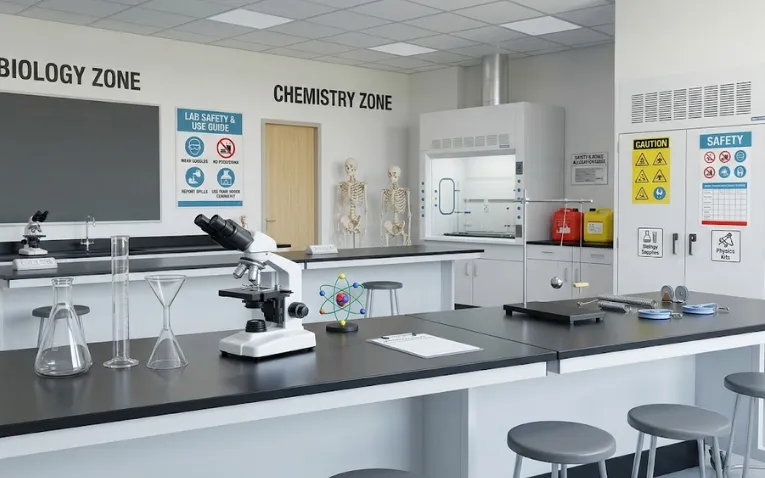
Selecting equipment based on price alone can result in unsuitable purchases or unnecessary replacements. Schools should assess their practical teaching requirements before preparing a procurement list.
1. Identify Curriculum Requirements
List the experiments required for each subject and grade level. Use this information to determine which instruments, apparatus and consumables are necessary.
2. Plan Quantities According to Class Size
Estimate the number of student groups working simultaneously. Some equipment may be shared between groups, while other items may be needed at each workstation.
3. Check Material Compatibility and Durability
Choose glassware, plasticware, instruments and work surfaces that are suitable for the intended chemicals, temperatures and activities.
4. Consider Safety and Maintenance
Plan equipment purchases alongside the overall education lab setup, considering workbenches, utilities, storage, ventilation and student movement. Read our guide to an efficient education lab setup for practical advice on coordinating laboratory equipment, furniture and safety.
5. Plan Space and Storage
Confirm that the laboratory can accommodate the equipment, students, furniture and required services without obstructing access or compromising safe working practices.
6. Set Priorities Within the Budget
Prioritise essential equipment needed for the curriculum and safety. Additional instruments can be purchased in phases according to teaching needs and available funding.
7. Consider an Integrated Science Lab
Schools with limited space or budgets can use an integrated science lab to support chemistry, physics and biology practicals. Shared equipment, flexible workstations and organised storage help optimise space and reduce unnecessary costs. Read our guide to integrated science lab planning for practical space and budget optimisation tips.
Conclusion
School lab equipment helps students turn scientific concepts into practical learning experiences through observation, experimentation and accurate measurement. A suitable combination of beakers, test tubes, microscopes, balances, thermometers, subject-specific apparatus and safety equipment supports effective science education.
However, an effective laboratory requires more than individual instruments. Schools must consider curriculum requirements, class size, safe working practices, equipment maintenance, storage and suitable laboratory furniture to create an organised and functional learning environment.
For schools developing a new laboratory or upgrading an existing one, Santech Labs, an experienced lab furniture manufacturer, provides laboratory furniture solutions designed around workspace, storage and practical requirements. Combining the right equipment with well-planned laboratory infrastructure helps schools create safe, functional and engaging science laboratories.