

The right fume hood size depends on your laboratory’s equipment, processes, available workspace, number of users and ventilation requirements. Common fume hood widths include 4-foot, 5-foot and 6-foot models, while compact and custom sizes are available for specialised applications.
A larger fume hood is not automatically better. It requires more floor space and can increase the airflow and exhaust capacity needed by the ventilation system. The final selection should therefore consider the hood dimensions alongside face velocity, sash position, ductwork, static pressure, contaminants and blower capacity.
In this guide, we explain how to determine the right fume hood size for your laboratory, what affects airflow and blower sizing, and when a custom configuration may be more suitable.
What Is the Standard Fume Hood Size?
There is no single fume hood size that suits every laboratory. You will find compact models as well as common 4-foot, 5-foot and 6-foot configurations. Larger and custom options are available when the work demands them.
| Fume Hood Size | Typical Application |
|---|---|
| Compact | Smaller laboratories and limited work |
| 4-foot | General laboratory applications |
| 5-foot | Larger equipment or more working area |
| 6-foot | Extensive processes or larger apparatus |
| Custom | Specialised equipment or workflows |
These sizes are useful for initial planning, but they should not be treated as fixed recommendations. The right laboratory fume hood dimensions depend on the equipment, processes, number of users, available laboratory space and ventilation requirements. For example, a laboratory using one large instrument may need more working width than one handling several smaller tasks.
Common Fume Hood Widths
Width gives you the horizontal working area. A 4-foot hood can be suitable for routine chemical work, while a 6-foot model offers more room for larger equipment and more involved setups.
But width alone does not tell you whether a hood will work. The real question is whether your equipment and process can fit comfortably without making the workspace cramped or interfering with airflow.
Fume Hood Depth and Height
Depth and height can become just as important as width once equipment enters the picture. An instrument may fit from side to side but still be too deep or too tall for the hood.
Measure the largest equipment before making a decision. Allow room around it for operation, connections and access rather than measuring only the equipment’s outer dimensions.
How Do You Determine the Right Fume Hood Size?
Finding the right fume hood size is easier when you start with the laboratory’s actual requirements instead of choosing a hood first.
1. Measure the Equipment You Need Inside

Start with everything that needs to sit inside the hood.
Check:
- Equipment width, depth and height
- Clearance around instruments
- Electrical connections
- Gas and water connections
- Drainage requirements, where applicable
- Space needed to operate controls
The equipment should fit without taking over the entire workspace. Leave enough room for handling materials and maintaining sensible airflow around the setup.
2. Define the Work Being Performed
The type of work has a direct bearing on the hood you need.
Routine solvent handling, acid digestion, heating, chemical reactions and pharmaceutical sample preparation can place very different demands on a hood.
The substances being used also matter. Materials and hood construction should be appropriate for the chemicals and processes involved.
For additional guidance on safe fume hood use, see our guide to common fume hood safety mistakes in laboratories.
3. Consider the Number of Users
Think about who will actually use the hood and how often.
If one person uses it at a time, a standard configuration may be sufficient. If several people need dedicated work areas, installing multiple appropriately sized hoods may be more practical than buying one very large unit.
4. Check Available Laboratory Space
Measure the room before deciding on the hood.
Look at:
- Walkways
- Adjacent benches
- Storage cabinets
- Doors and windows
- Emergency equipment
- Utility connections
- Duct routing
- Maintenance access
A hood may fit the available floor area but still make the laboratory difficult to navigate. Its position should work with everything around it. For a broader approach to laboratory space planning, equipment placement and workflow, see our guide on how to design a successful laboratory.
5. Consider Future Requirements
Laboratories rarely stay exactly the same. New equipment, additional processes or changes in workload may come later.
If you already know that the laboratory will expand, account for those requirements now. It is usually easier to plan for them during the initial design than to rework the space later.
Does Fume Hood Size Affect Airflow?
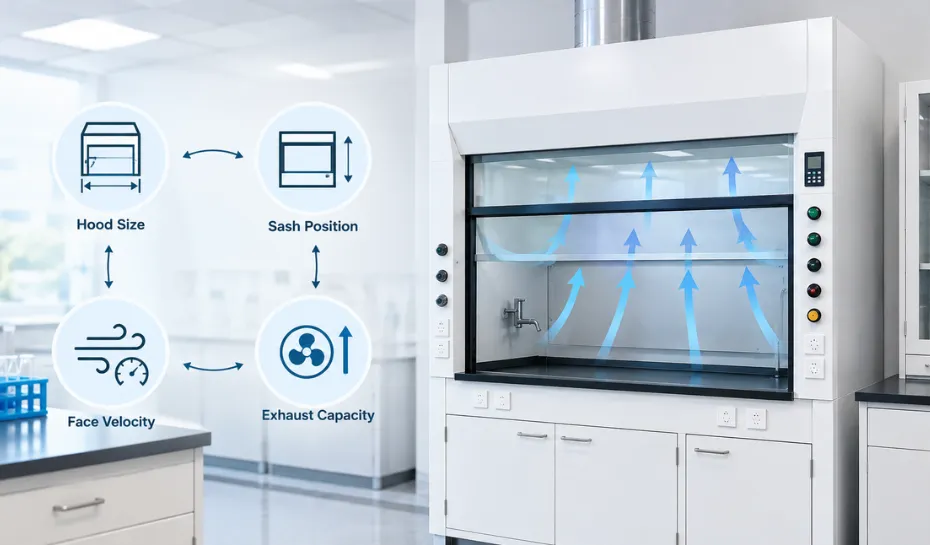
Yes. The size of the hood opening and the position of the sash both influence the amount of air that needs to move through the system.
That makes hood dimensions, sash position, face velocity and exhaust capacity closely linked. Changing one can affect the others.
Understanding Face Velocity
Face velocity refers to the speed of air moving through the open face of the hood. It is one of the measurements used to assess how the hood is performing.
The airflow requirement cannot be determined from hood width alone. Hood design, sash position, containment requirements and the work being carried out all have a role.
Why a Larger Hood May Require More Air
A larger opening can mean more air has to be moved to maintain the required operating conditions.
When planning laboratory equipment alongside a fume hood, specialised workstations and equipment-support furniture should also be considered. For applications involving sensitive instruments, you can learn more about how anti-vibration tables improve accuracy in laboratories.
The basic relationship looks like this:
So, choosing a larger hood without checking the exhaust system can create fume hood safety issues later, particularly when the ductwork and blower have already been planned.
What Is Fume Hood Blower Sizing?
Fume hood blower sizing is the process of selecting a fan that can deliver the required airflow while handling resistance throughout the exhaust system.
The hood’s width is only one piece of that calculation.
Why Oversizing or Undersizing the Blower Can Be a Problem
A blower that cannot deliver enough airflow may affect the hood’s performance. Going to the other extreme and installing a much larger blower is not automatically better. It can increase energy use without solving the underlying design issue.
The hood, ductwork and blower need to be considered together from the start.
How Do Different Types of Laboratory Fume Hoods Affect Sizing?
The types of laboratory fume hoods available are built around different applications. The right dimensions therefore depend partly on what the hood is expected to handle.
| Fume Hood Type | Key Considerations |
|---|---|
| Ducted Chemical Fume Hoods | Connect to an external exhaust system and are commonly used for chemical laboratory work. Consider the exhaust route, airflow requirement and blower capacity before installation. |
| High-Performance Fume Hoods | Designed to provide effective containment at lower face velocities in some configurations. Performance should be assessed using manufacturer specifications and test data rather than dimensions alone. |
| Walk-In Fume Hoods | Suitable for large apparatus, tall equipment or processes requiring greater working volume. Plan floor space, operator access, airflow and exhaust infrastructure before installation. |
| Filtered or Ductless Fume Hoods | Use filtration instead of a conventional external exhaust connection in many configurations. Suitability depends on the chemicals involved and the filtration system, so chemical compatibility should be checked carefully. |
When Should You Choose a Custom Fume Hood Size?
Standard sizes cover many laboratory applications, but they are not suitable for every setup.
A custom configuration may be worth considering for:
- Oversized equipment
- Specialised laboratory processes
- Unusual room dimensions
- Walk-in applications
- Multiple-user workflows
- Special material requirements
- Existing ductwork constraints
The reason for going custom should come from the laboratory’s requirements. If the equipment, process or room cannot be accommodated properly by a standard model, custom sizing can provide a better fit.
How to Choose a Laboratory Fume Hood Supplier
Choosing a supplier should involve more than comparing hood sizes and prices. Look for a supplier that understands your laboratory application, ventilation requirements, equipment, available space and overall workflow. For projects that require coordinated planning, turnkey laboratory solutions in India can help bring laboratory furniture, utilities, equipment integration and installation together as part of one complete setup.
Look Beyond Hood Dimensions

Consider the hood’s:
- Construction and materials
- Ventilation requirements
- fume hood safety features
- Available configurations
- Testing requirements
- Installation support
- Maintenance provisions
These details can have a significant impact on how the hood performs once it is installed.
Choose a Supplier That Understands the Complete Laboratory
A laboratory usually includes much more than a fume hood. Benches, storage, utility services and other furniture need to work around it.
An experienced Lab furniture supplier can help coordinate these elements as part of the same laboratory plan, rather than treating each purchase as a separate decision.
Choose the Right Fume Hood Size for Your Laboratory
Choosing the right fume hood size depends on the work area, equipment dimensions, laboratory workflow, available space and required ventilation capacity—not simply whether you need a 4-, 5- or 6-foot hood. The hood should provide sufficient working space while matching the laboratory’s exhaust and airflow requirements.
For a practical selection, consider the hood dimensions, equipment size, working clearance, airflow requirements, ducting and blower capacity during the planning stage. This helps avoid space constraints, ventilation issues and costly modifications later.
If you are planning a new laboratory or upgrading an existing facility, Santech Labs can help you select and integrate the right fume hood with your laboratory workstations, storage systems and overall layout. As experienced lab furniture manufacturers, we can support your laboratory planning based on your application and space requirements.
Need help choosing the right fume hood for your laboratory? Contact Santech Labs to discuss your laboratory layout, application requirements and fume hood configuration.